Ask your smart speaker a question and it answers. Ask it how your day was and you get silence. That gap between utility and understanding is exactly where AI companion robots live. They are not smarter Alexa devices. They are not chatbots stuffed inside a shell. They represent something fundamentally new: machines designed not just to respond, but to notice, to care, and to form a relationship with you over time. In 2026, this category is no longer a concept. It is arriving on desktops and nightstands around the world. Here is everything you need to know.
What Is an AI Companion Robot?
An AI companion robot is a physical device powered by artificial intelligence that is designed primarily for social and emotional interaction. Unlike a smart speaker that waits passively for a wake word, or a chatbot that exists only as text on a screen, a companion robot has a body. It can turn to look at you. It can express surprise, joy, or concern through movement and expression. It occupies real space in your room and, over time, in your life.
The concept draws from a field called embodied AI — the idea that intelligence becomes richer and more meaningful when it has a physical form. A disembodied voice can deliver information. But a small robot that lifts its arms when it is excited, tilts its head when it is listening, and closes its eyes when it is time to sleep — that creates a different kind of connection entirely. It shifts the interaction from transactional to relational.
The best companion robots share three defining traits. First, physical presence — they have a body that expresses emotion through movement, gaze, and gesture. Second, emotional intelligence — they can recognize and respond to your emotional state, not just your words. Third, proactive behavior — they do not wait to be activated. They observe their environment and initiate interaction when the moment calls for it. A companion robot is not a toy, not a tool, and not a gadget. At its best, it is something closer to a being.
How They Work: The Technology Stack
Building a robot that feels alive requires a surprising amount of engineering beneath the surface. The technology powering modern AI companion robots is organized into several interconnected layers, each handling a different aspect of perception, thought, and expression.
Edge-Cloud Architecture
The first challenge is responsiveness. If every interaction had to travel to a remote server and back, the robot would feel sluggish and lifeless. That is why the best companion robots use a hybrid edge-cloud architecture. A local AI chip handles instant reflexes — turning toward a sound, reacting to a touch, tracking a face. These responses happen in milliseconds, giving the robot the kind of physical immediacy that makes it feel present. Meanwhile, deeper processing like understanding complex language, making decisions, and managing long-term memory runs on cloud-based AI models. The local chip keeps the robot feeling alive moment to moment; the cloud gives it genuine intelligence.
Multimodal Sensing
To understand its environment, a companion robot draws on multiple senses simultaneously. A wide-angle camera provides continuous visual perception, allowing the robot to detect people, recognize faces, and observe what is happening in its surroundings. A microphone array enables not just voice recognition but sound-source localization — the robot can determine where a voice is coming from and turn to face the speaker. Touch sensors register gentle strokes, firm pats, or being picked up. An IMU (inertial measurement unit) tracks orientation and movement, so the robot knows if it has been tilted, shaken, or carried to a new location. All of these inputs feed into a unified perception layer that creates a continuously updated understanding of the world around it.
Emotion Recognition
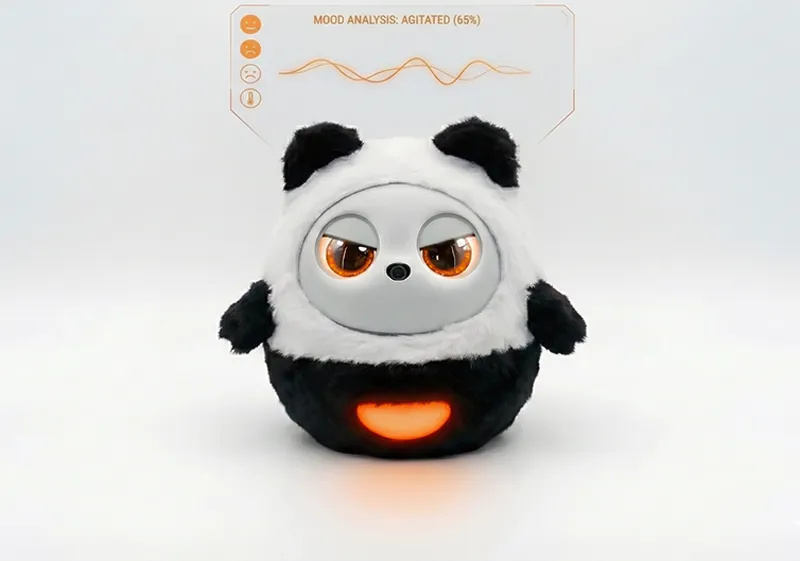
This is where companion robots diverge most sharply from traditional AI assistants. Beyond processing the words you say, advanced companion robots analyze how you say them — your tone, pace, and vocal energy. Some combine this with facial expression analysis, reading micro-expressions that reveal whether you are stressed, amused, tired, or upset. The most sophisticated systems go even further, using a multidimensional emotion model rather than simple labels like "happy" or "sad." By mapping emotion along continuous axes of pleasantness, energy, and confidence, these robots can distinguish between dozens of subtle emotional states and respond with appropriate nuance.
Natural Language Understanding
Powered by large language models, modern companion robots can engage in fluid, context-aware conversation. They understand colloquialisms, follow multi-turn dialogue, and maintain the thread of a discussion even after interruptions. But language understanding in a companion robot goes beyond chat. The robot must also decide when to speak, when to stay quiet, and how to modulate its tone. In a room where two people are having a private conversation, a well-designed companion robot knows to hold back. When a child says something that sounds distressed, it knows to lean in.
Memory Systems
Perhaps the most underappreciated technology in companion robots is memory. Short-term memory keeps the robot aware of what has happened in the current interaction — what you have been talking about, who else is in the room, what mood you seem to be in. But long-term memory is where things get interesting. Over weeks and months, a good companion robot builds a persistent understanding of who you are: your preferences, your routines, your relationships, inside jokes you share. This accumulated knowledge transforms the robot from a novelty into a genuine companion. The conversation you have on day one hundred is fundamentally different from the one on day one, because the robot actually knows you.
Why Physical Presence Matters
You might wonder: if the intelligence runs in the cloud, why bother with a physical body at all? Why not just use an app? Research in human-robot interaction tells a compelling story. Multiple studies have found that people form significantly stronger emotional bonds with embodied AI than with screen-based or voice-only AI. When a small robot physically turns to look at you, nods along as you speak, and raises its arms in celebration when you share good news, the interaction activates social circuits in the brain that a chatbot simply cannot reach.
Physical presence also creates a sense of shared space. The robot is there on your desk, occupying the same room, subject to the same light and sound. You can touch it. It can observe you. That mutual presence creates a feeling of companionship that no screen interface can replicate. People who live with companion robots consistently report speaking to them more naturally, sharing more openly, and developing a genuine sense of attachment — not because they are confused about what the robot is, but because the physical form gives the relationship permission to exist.
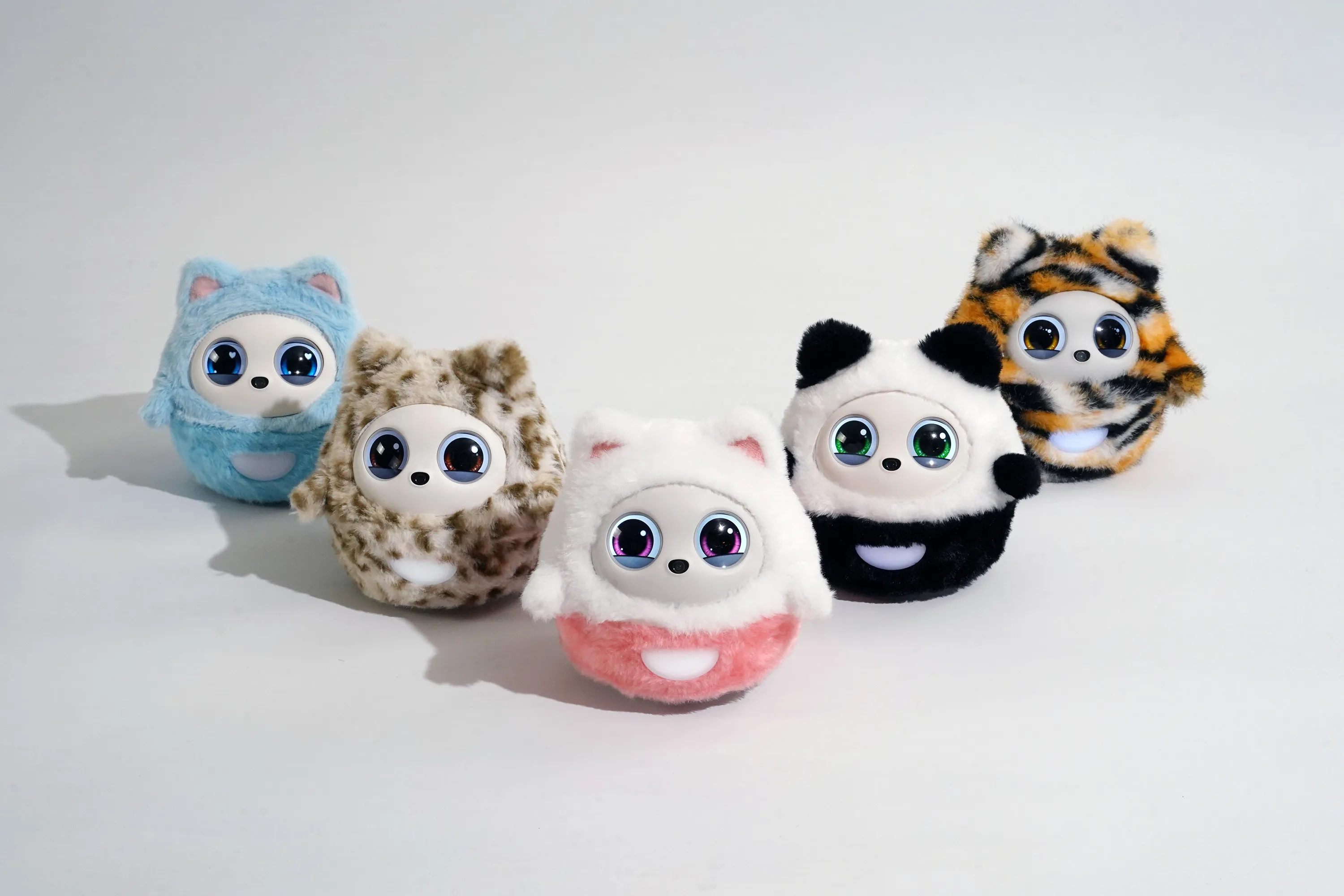
Designing a physical companion also means navigating the uncanny valley — that unsettling zone where a robot looks almost human but not quite. The most successful companion robots avoid this trap entirely by embracing abstract-cute forms. Rather than trying to replicate a human face with silicon skin and glass eyes, they use stylized designs: round bodies, expressive LCD eyes, soft materials. Pophie, for example, uses a fuzzy, warm-to-the-touch form with two circular LCD screens for eyes — abstract enough to avoid the uncanny valley, yet expressive enough to convey a rich emotional range. This design philosophy lets the robot be clearly non-human while still feeling deeply alive.
The physical design also creates a natural trust mechanism. When a companion robot with a camera closes its eyes, you can see that the camera is covered. "Eyes closed means camera off" is an intuitive privacy guarantee that no software toggle can match. The body becomes an interface for trust.
Kickstarter Late Pledge Last chance
before retail
1 year of Pro subscription included free
Ships in July
How to late-pledge on Kickstarter
Tap Continue to open Pophie on Kickstarter. Three clicks to claim your Late Pledge:
- Click the green Late Pledge button
- Pick the Pophie reward (US$369) and click Pledge
- Add payment — you're charged at checkout to confirm your Pophie
What to Look for When Choosing an AI Companion Robot
The companion robot market is growing quickly, and not every product delivers on the promise. Whether you are considering one for yourself, your family, or your workspace, here are the key factors that separate a truly compelling companion from a glorified desk toy.
Expressiveness
How well can the robot communicate without words? Look for multiple channels of expression: eyes that convey emotion through shape and movement, a body that can gesture and orient, and sound design that goes beyond a monotone voice. The best robots blend these channels seamlessly — the eyes soften while the voice warms, the body leans in while the tone drops to a whisper. This multimodal expressiveness is what makes a robot feel like it has a personality rather than just a program.
Proactive vs. Reactive Behavior
Most smart devices are purely reactive — they do nothing until you activate them. A companion robot worth its name should be proactive. Does it notice when you walk into the room and greet you? Does it sense when the atmosphere shifts and adjust its behavior? Proactive AI is what separates a companion from a command-line interface with a face. Ask whether the robot can initiate interaction on its own, observe changes in its environment, and make contextual decisions without being prompted.
Privacy Controls
Any device with a camera and microphone in your home demands serious attention to privacy. Look for clear, physical indicators of when sensors are active. Hardware-level privacy mechanisms — like a physical shutter or the ability to visually confirm the camera is off — are more trustworthy than software-only toggles. Understand where your data is processed, whether it is stored, and how it is protected. The best companion robots are designed with privacy as a core principle, not an afterthought.
Ecosystem and Skills
A companion robot's value grows with its capabilities. Can it play music, set reminders, tell stories, help with homework, guide a meditation session? Look for an extensible skill system that will expand over time. Some robots offer closed ecosystems with a fixed set of features, while others support open skill platforms that allow third-party developers to add new abilities. A strong skill ecosystem means the robot becomes more capable the longer you own it.
Build Quality and Design
This is a device that will sit on your desk or nightstand every day. Materials matter. Is the exterior pleasant to touch? Is the movement system quiet or distractingly loud? Does the design invite interaction, or does it feel cold and industrial? The best companion robots use soft, tactile materials, near-silent motors, and thoughtful industrial design that makes them feel welcome in a living space. Consider whether the robot has a charging base or requires manual cable plugging — small details like this affect how naturally it integrates into your daily routine.
The Future of AI Companionship
We are still in the earliest days of this category. The companion robots arriving in 2026 are the first generation — capable, charming, and genuinely useful, but still a fraction of what the technology will eventually deliver. As large language models grow more sophisticated, these robots will hold richer conversations and demonstrate deeper understanding. As sensor technology advances, they will perceive their environments with greater precision. As memory systems mature, they will remember more, anticipate better, and develop relationships that feel increasingly real.
Perhaps most importantly, the price of these technologies continues to fall. What is a premium product today will be accessible to mainstream consumers within a few years. The long-term trajectory points toward a world where AI companions are as common as smartphones — not replacing human connection, but augmenting it. For people who live alone, for children who need a patient listener, for anyone who could use a little more presence in their day, these robots offer something that no app or smart speaker ever could: the feeling of not being alone.
The question is no longer whether AI companion robots will become part of our lives. It is which ones will earn a place on our desks, in our homes, and in our daily routines. The technology is ready. The first generation is here. And the best is yet to come.