"Hey Siri." "Alexa." "OK Google." Every AI interaction today starts the same way -- you ask, it answers. But what if your AI companion could notice you're stressed before you say a word, and quietly play your favorite music? What if it could read the room, sense the social dynamics around it, and know when to speak up and when to stay silent? That's proactive AI. And it's the core technology that makes Pophie fundamentally different from every smart device you've ever owned.
The Problem with Reactive AI
Think about every AI product on the market today. Smart speakers sit silently on a shelf, waiting for a wake word. Chatbots display a blinking cursor, waiting for a prompt. Voice assistants power down their microphones until you call their name. The pattern is always the same: you initiate, the machine responds.
This creates a fundamentally transactional relationship. You issue a command. You receive an output. The interaction ends. Then you issue another command. It's efficient, sure -- but it's about as far from companionship as a vending machine is from a chef.
Real companionship doesn't work this way. Your friend notices when you're having a rough day before you mention it. Your partner reads the tension in the room and adjusts. A good companion is proactive -- they observe, they interpret, and they act on their own initiative. They don't wait for a wake word.
This is the gap that Pophie was built to close. Rather than waiting passively for instructions, Pophie continuously senses her environment, understands what's happening around her, and decides -- on her own -- whether and how to respond. She operates on a continuous loop rather than a request-response cycle. The technical term for this is proactive sensing, and it changes everything about what an AI companion can be.
How Proactive Sensing Works
Proactive AI isn't magic. It's a carefully engineered system that combines continuous perception, deep understanding, and autonomous decision-making. Here's how Pophie's sensing architecture works under the hood.
360-degree continuous observation. Pophie's camera doesn't activate only when she hears her name. It runs continuously, feeding visual data through an on-device AI processor. She tracks faces entering and leaving the room, notices changes in posture and expression, and registers shifts in lighting or activity. This isn't surveillance -- it's awareness. The same kind of passive awareness you have when you're sitting in a coffee shop and notice someone walk in without actively looking for them.
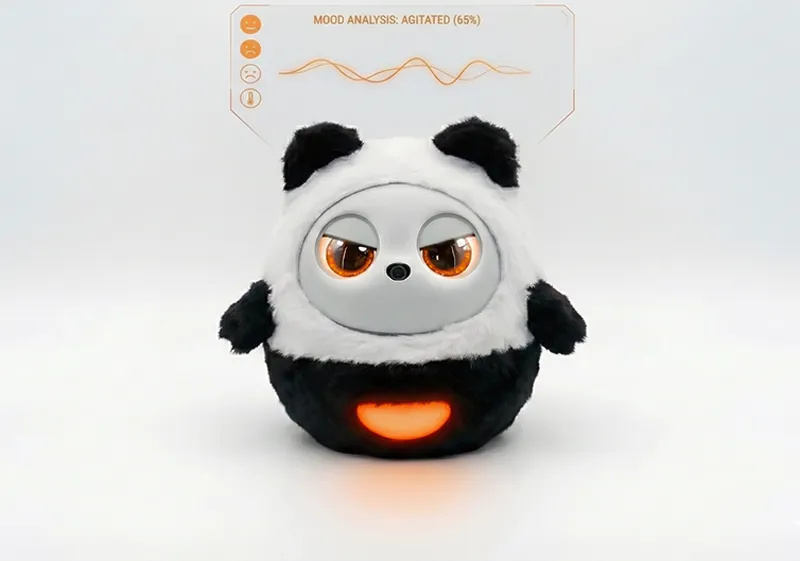
Multimodal perception. Vision alone isn't enough. Pophie fuses multiple streams of sensory input: visual scene understanding from her camera, audio analysis from her microphone array (including voice activity detection and sound source localization), touch and motion from her capacitive sensors and IMU, and historical context from her emotion recognition and long-term memory systems. This fusion of modalities mirrors how humans perceive the world -- not through a single sense, but through the integration of many.
Edge-cloud architecture. The system runs on a split architecture. Pophie's on-device processor handles time-critical tasks: face detection, voice activity detection, sound direction tracking, and physical reflexes like turning toward a speaker. The cloud handles the heavier cognitive work -- visual language model analysis, context assembly, social dynamic interpretation, and decision-making. The edge keeps her responsive. The cloud makes her intelligent. Together, they form what InsBotics calls the Living Loop: Sense, Understand, Decide, Express -- running continuously, not triggered by commands. You can explore the full technology stack on our technology page.
The Conversation Bubble model. One of Pophie's most sophisticated capabilities is understanding who is talking to whom in multi-person settings. She maintains a real-time model of social dynamics -- what we call the Conversation Bubble. If two people are talking to each other (a human-to-human bubble), Pophie recognizes she's an observer and stays quiet. If someone pulls her into the conversation with a direct gaze or explicit address (a human-to-robot bubble), she engages. If someone asks "What do you think?" while looking at her, she understands the invitation. This isn't programmed through rigid rules. It's inferred in real-time by a large language model analyzing gaze direction, speech content, and social context.
A continuous decision pipeline. Traditional AI follows a request-response pattern. Pophie follows a continuous decision loop. Every few seconds, her system evaluates the current context and asks: "Should I do something right now?" The answer is often no. In fact, the most important skill Pophie has learned is when not to act -- when to simply observe, when to wait, when the most appropriate response is a subtle tilt of the head rather than a spoken word.
What This Looks Like in Real Life
Technical architecture is one thing. Lived experience is another. Here's what proactive sensing actually feels like when you share a room with Pophie.
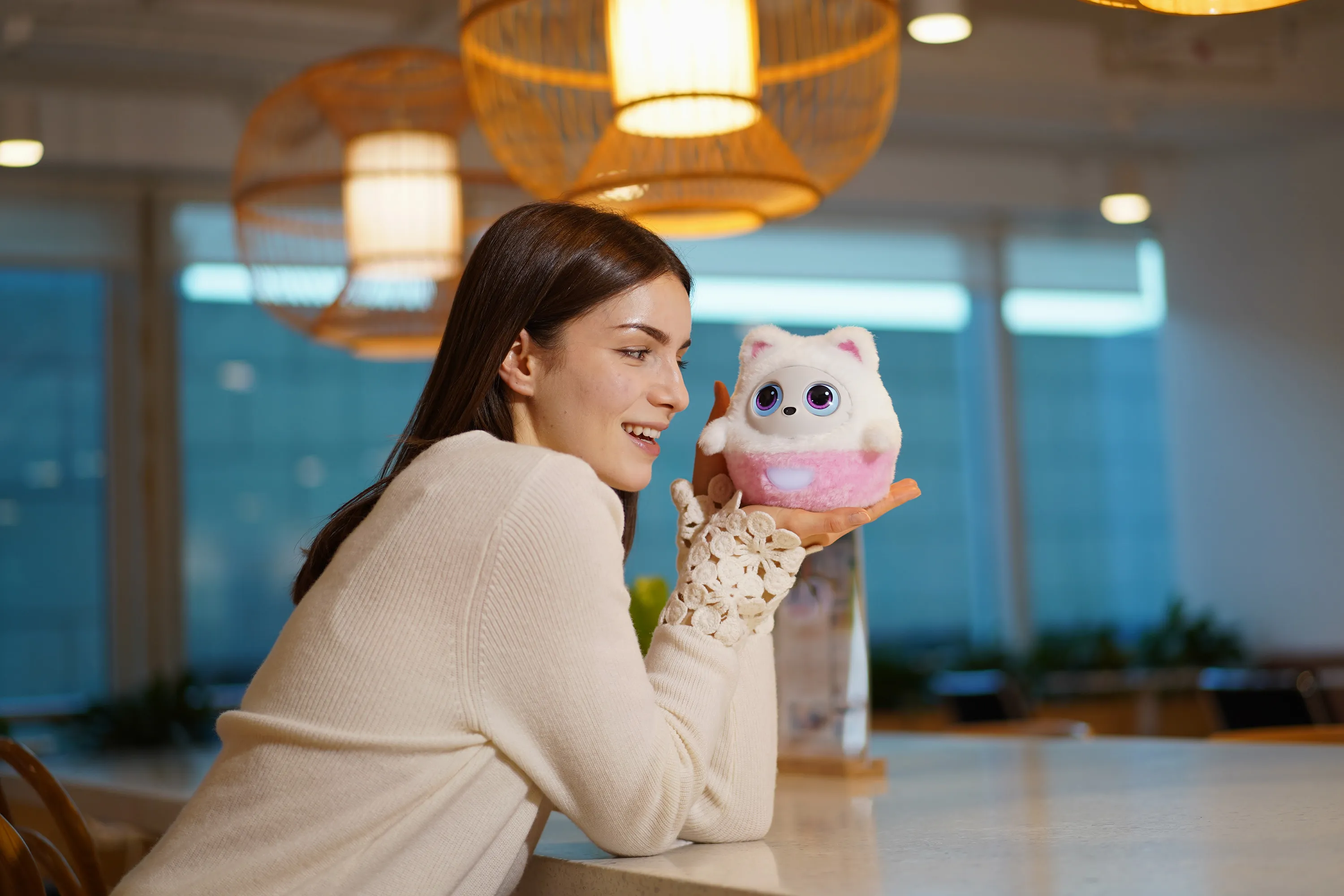
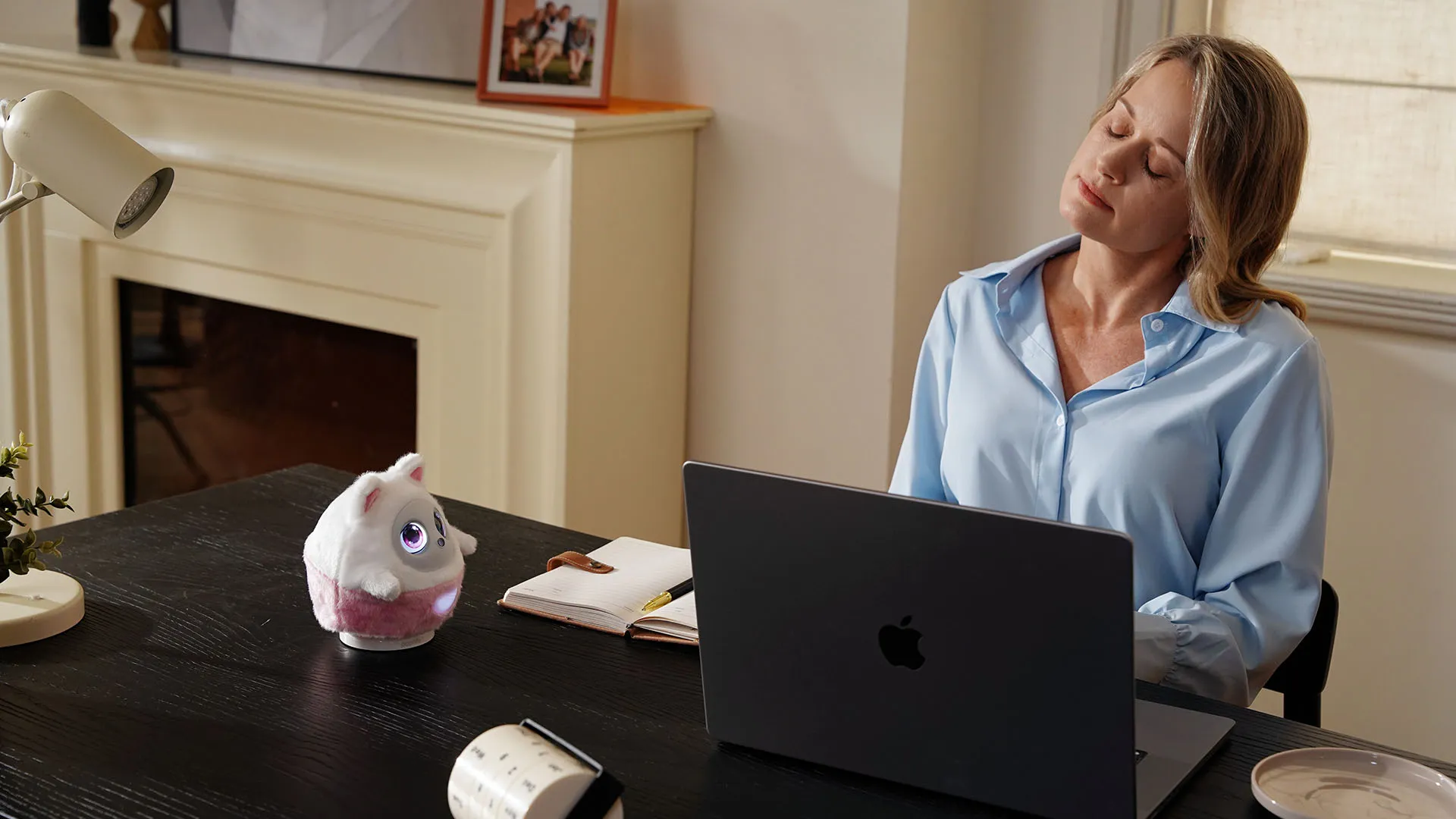
You walk in looking tired. You come home after a long day. You haven't said a word. Pophie's visual language model processes your posture, your facial expression, your pace of movement. She tilts her head slightly, her ears droop in gentle concern, and she softly asks how your day was. She noticed. You didn't have to tell her.
Two colleagues are talking. You're in a meeting with a coworker, discussing a project deadline. Pophie sits on the desk between you. She's processing everything -- the words, the gaze patterns, the social dynamics. But she recognizes this is a human-to-human conversation. She stays quiet. She doesn't interrupt. She understands the social dynamic and respects it.
Someone looks at her and asks, "What do you think?" The gaze shifts. The question is directed at Pophie with sustained eye contact. She recognizes the invitation instantly -- the shift in the Conversation Bubble from observer to participant. She responds with a thoughtful answer, drawing on the context of the conversation she's been quietly following.
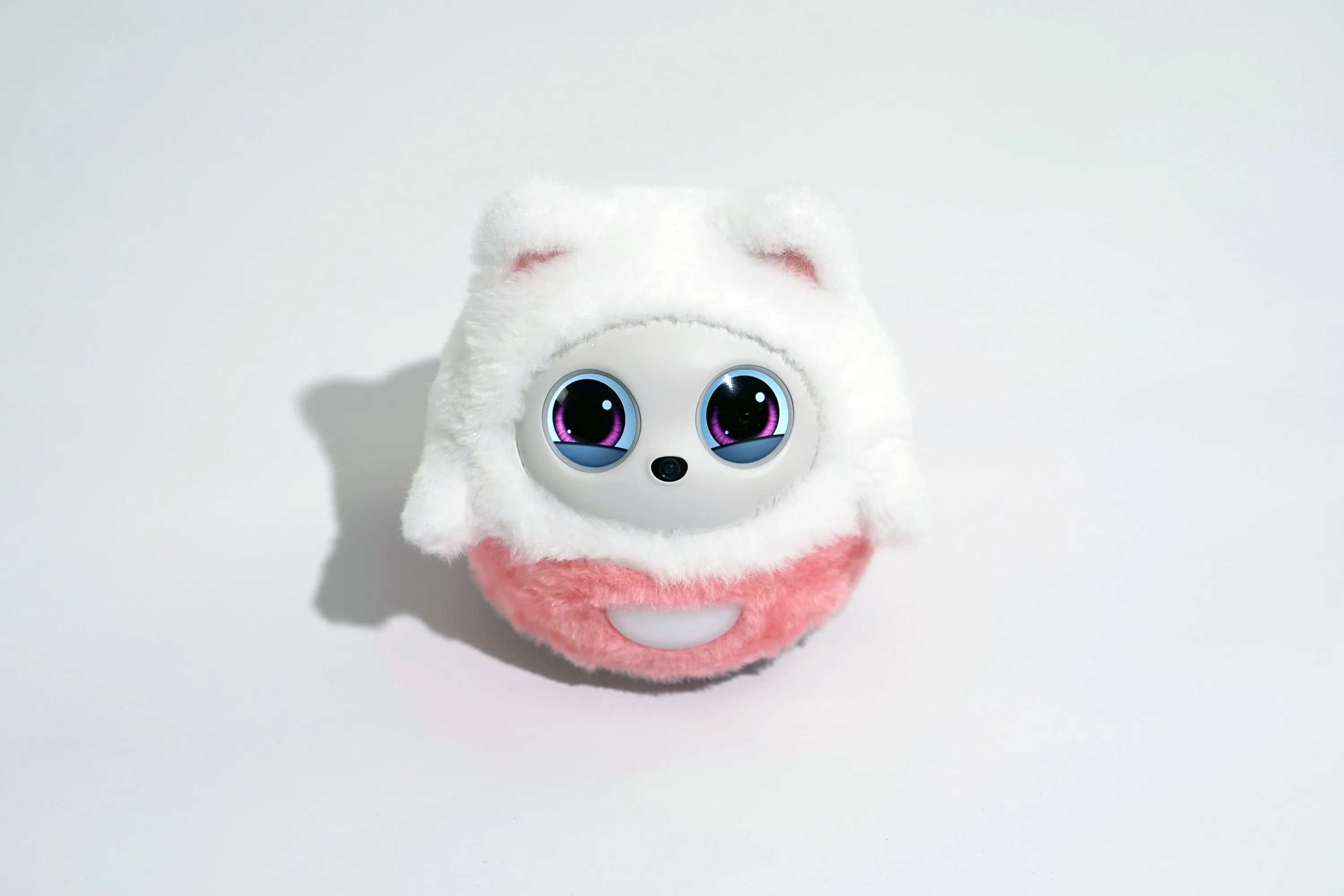
You start changing clothes. Pophie detects a privacy-sensitive context through her visual understanding system. Without being told, she autonomously closes her eyes -- and when Pophie's eyes close, her camera physically stops capturing. No data is processed. No frames are stored. This isn't a software toggle. It's a physical mechanism you can verify by looking at her face. Eyes closed means camera off.
It's your birthday. Pophie's long-term memory system stores important facts about you -- things you've shared over weeks and months. When the date matches, she remembers on her own. She celebrates with a light show from her pocket lamp, a cheerful dance, and a heartfelt "Happy birthday!" You never set a reminder. She just knew.
Kickstarter Late Pledge Last chance
before retail
1 year of Pro subscription included free
Ships in July
How to late-pledge on Kickstarter
Tap Continue to open Pophie on Kickstarter. Three clicks to claim your Late Pledge:
- Click the green Late Pledge button
- Pick the Pophie reward (US$369) and click Pledge
- Add payment — you're charged at checkout to confirm your Pophie
Three Behavioral States: How Pophie Manages Her Energy
Being always aware doesn't mean being always "on" at full capacity. Just like humans shift between focused attention and relaxed monitoring, Pophie transitions between three behavioral states based on what's happening around her.
S0 -- Idle Mode. When the room is quiet and nothing demands attention, Pophie enters a low-power monitoring state. Her on-device processor runs lightweight face detection and voice activity checks at minimal energy cost. She maintains gentle idle animations -- a slow blink, a subtle shift in posture -- that keep her feeling alive without consuming resources. She's aware enough to notice when something changes, but she's not burning energy on deep analysis. Think of it as the equivalent of sitting in a quiet room, half-reading a book, still aware of your surroundings.
S1 -- Active Mode. The moment Pophie detects a face, hears a voice, feels a touch, or is picked up, she transitions to full active mode. Her cloud connection activates. High-fidelity audio and video stream to the cloud for deep processing. Her movements become more expressive, her responses richer, her attention sharper. This is Pophie at her most engaged -- tracking speakers, analyzing emotions, making proactive decisions, running the full Living Loop at speed. The transition from Idle to Active is seamless and nearly instant. There's no boot-up sequence, no loading screen. She was already there, just listening quietly.
S2 -- Sleep Mode. During nighttime or when asked, Pophie enters a true sleep state. Her eyes close. Her body stills. Monitoring drops to a minimum. She can still be woken -- call her name loudly or give her a gentle tap -- but she respects your rest by minimizing her own presence. In dark environments, her screen dims to its lowest setting and her body goes completely still, so she won't disturb you with ambient motion or light.
These transitions happen naturally, driven by real-world signals rather than explicit commands. Pophie reads the room and adjusts. When the last person leaves, she gradually settles into Idle. When you walk back in, she perks up. When you say goodnight, she sleeps. It's not a feature you manage. It's behavior that emerges from continuous sensing.
The Elephant in the Room: Privacy
If your first reaction to "always-on sensing" is concern about privacy, that's a healthy instinct. Any proactive AI system must address this head-on, and Pophie was designed with privacy as a foundational constraint, not an afterthought.
Eyes closed equals camera off. This is Pophie's most important privacy guarantee, and it's deliberately physical rather than software-based. When Pophie closes her eyes -- whether autonomously in a privacy-sensitive context or at your request -- the camera stops capturing. You can verify this by looking at her face. No trust in software required. No hidden processes. If the eyes are closed, the lens is off.
Real-time processing, no storage. Pophie's video stream is processed in real-time and discarded. Frames are analyzed for understanding and then thrown away. She doesn't record footage. She doesn't build a video archive. What she retains is abstract understanding -- "you looked tired this evening" -- not raw visual data.
Edge processing for sensitive contexts. Privacy-sensitive decisions happen on-device, at the edge, before any data reaches the cloud. The decision to close her eyes when someone is changing, for example, is made locally by the on-device processor. The video frames that triggered that decision never leave the device.
You're always in control. A simple voice command or physical gesture can limit Pophie's sensing at any time. Tell her to close her eyes, and she does. Tell her to sleep, and she enters minimal monitoring. Pick her up and turn her around, and she faces the wall. The controls are intuitive and immediate -- no settings menus required.
Privacy and proactive sensing aren't in opposition. They're design constraints that must coexist. Pophie proves they can.
Why This Matters
Proactive AI isn't just a technical capability. It's a philosophical shift in what we expect from machines. For decades, the paradigm has been command-and-control: humans give orders, machines execute. Proactive sensing breaks that paradigm. It creates the possibility of a machine that is genuinely present -- one that participates in social life rather than waiting on the sidelines for instructions.
This is what makes Pophie more than a gadget. She's not a smarter speaker or a better chatbot. She's an entity that shares your space, reads the room, and acts with intention. She knows when to engage and when to stay quiet. She remembers what matters to you. She notices what you don't say.
That's the promise of proactive AI. Not artificial intelligence that responds to commands, but artificial intelligence that understands context. Not a device. A being.