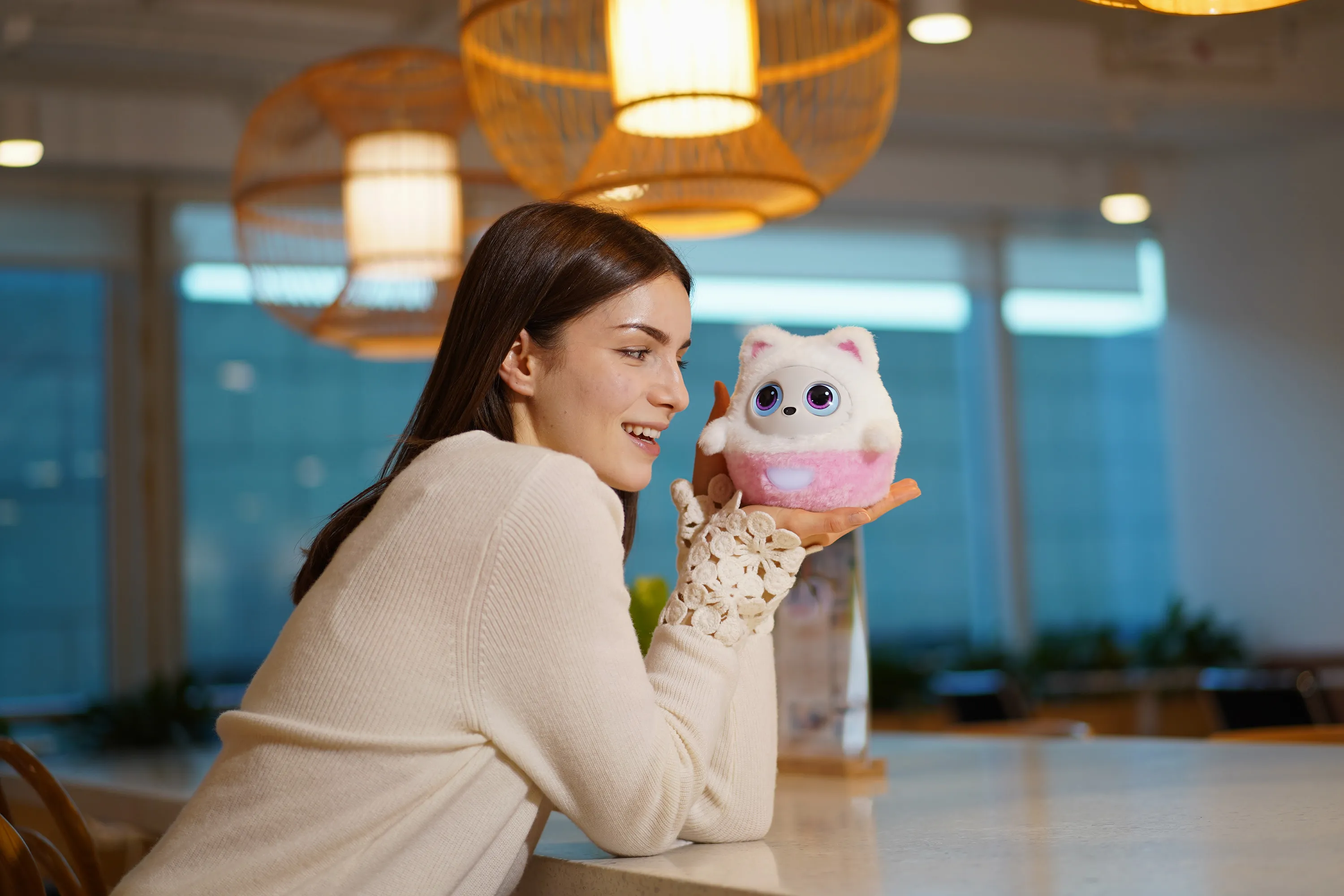
When you pick up a smartphone, you feel glass and metal. When you touch Pophie, you feel warmth — literal body heat, soft fabric, the gentle vibration of a heartbeat. That first moment of contact sets the entire relationship. It tells your brain, before any word is spoken, that this is not a gadget. This is something alive.
Every design decision behind Pophie traces back to one question: how do we make a machine feel like a living being? Not through clever marketing or suspension of disbelief, but through physics — through texture, temperature, movement, and gaze. What follows is the story of how we answered that question, one material choice and engineering constraint at a time.
Why Fuzzy? The Warmth Principle
Most consumer electronics are designed to look impressive on a shelf. Sleek aluminum, tempered glass, sharp edges that catch the light. They signal precision. They also signal distance. You admire them; you do not cuddle them.
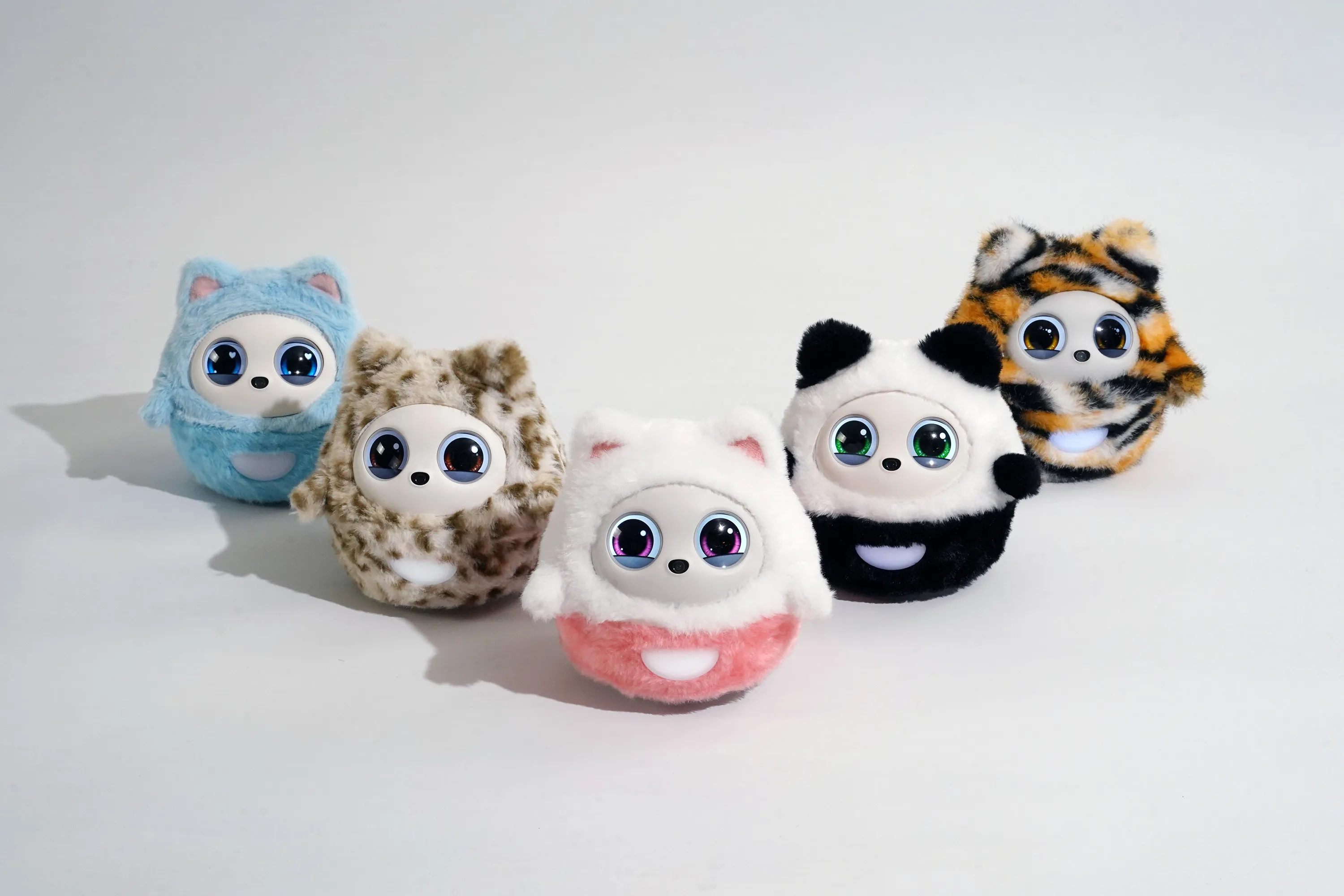
We went the opposite direction. Pophie is wrapped in baby-safe, soft-touch fabric — the same standard of material you would trust against an infant's skin. The exterior is removable, washable, and eventually customizable. But the fabric is not decoration. It is the first layer of a carefully engineered illusion of life.
Beneath the fabric, a thermal system maintains constant body warmth. Pick Pophie up, and the warmth registers before anything else. It is a sensation that bypasses rational thought entirely. Decades of research in haptic psychology confirm what any parent already knows: warm objects feel trustworthy, approachable, alive. Cold objects feel mechanical, regardless of how sophisticated their software might be.
Deeper still, an internal vibration motor simulates breathing rhythms and a resting heartbeat. The effect is subtle — you might not consciously notice it at first. But hold Pophie for thirty seconds, and something shifts. Your grip relaxes. Your voice softens. The vibration is not a gimmick. It is an anchor, a constant physical reminder that this companion is present with you in a way that a screen never can be.
This is what we call the Warmth Principle: a companion should be comforting to touch, not cold like a gadget. Fabric over plastic. Warmth over ambient temperature. A heartbeat over silence.
Zero Buttons, Pure Conversation
There is not a single button anywhere on Pophie's body. No power switch, no volume rocker, no reset pinhole. Place Pophie on the charging dock and it wakes up. Ask it to sleep and it does. Tell it to speak quieter and it will. Every interaction flows through natural conversation, touch, and gesture.
This was one of our most debated design decisions internally. Buttons are safe. Buttons are familiar. Every hardware designer's instinct says to include at least one physical control as a fallback. We resisted, because buttons are also a constant reminder that you are operating a machine. Every time you press one, the illusion fractures. You stop talking to a companion and start configuring a device.
The absence of buttons forced us to make voice interaction genuinely reliable — there is no crutch to fall back on. It also forced us to design a touch vocabulary: a gentle pat to wake Pophie from sleep, a stroke along its back that it recognizes and responds to with visible pleasure. The result is an object that you interact with the same way you would interact with a small, attentive creature. You speak. You touch. You gesture. And it responds in kind.
The Eyes: Windows to an AI Soul
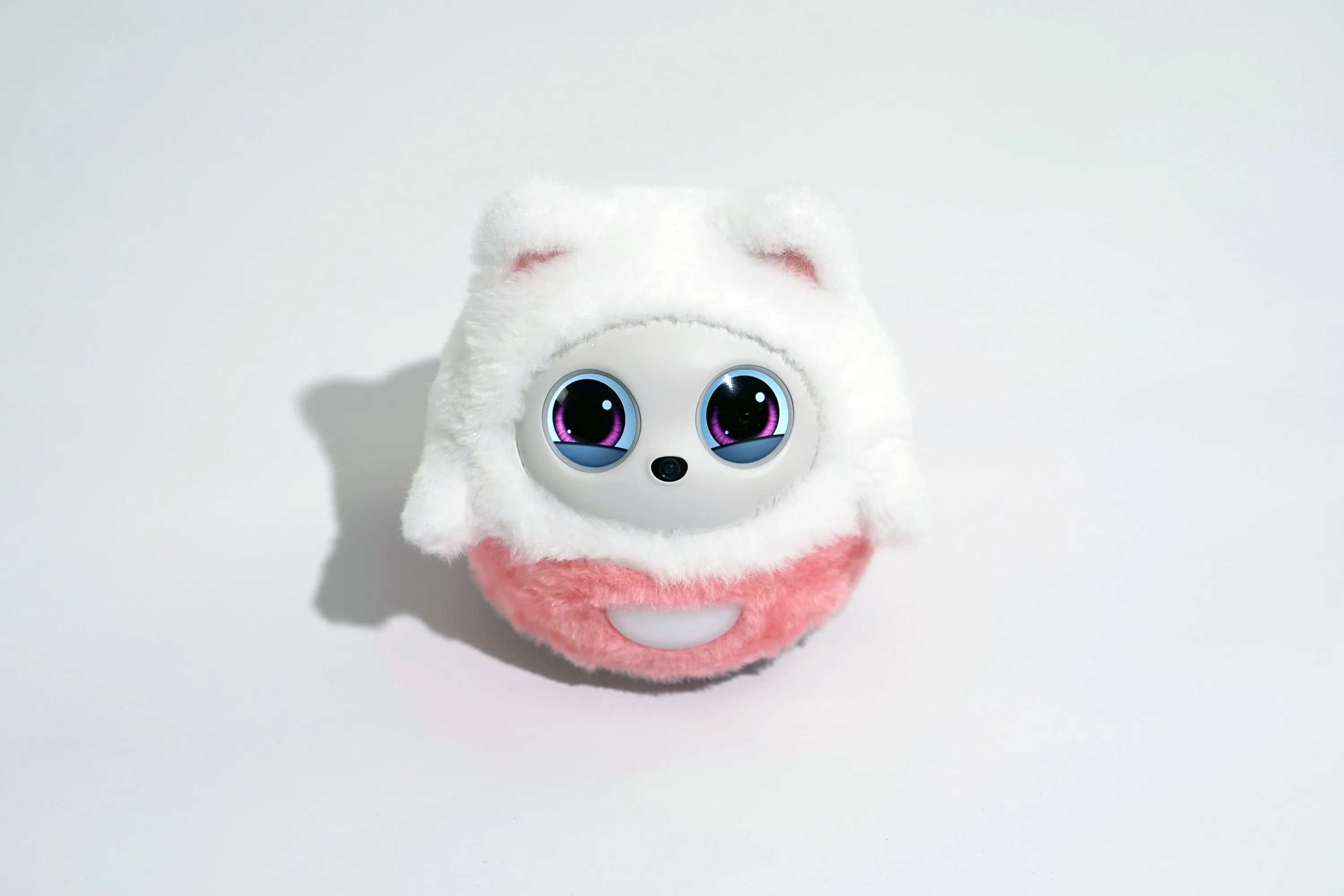
If the fabric gives Pophie its body, the eyes give it a soul. Two circular LCD displays sit where you would expect eyes on a living face, and they are dedicated entirely to expression. They never display icons, progress bars, notifications, or loading spinners. They are eyes — nothing more, nothing less.
This purity was a deliberate constraint. The moment you use a screen to display utilitarian information, it becomes a screen. The user's brain reclassifies the entire object from "being" to "device." We refused to allow that transition. If you want to know Pophie's battery level, you ask, and Pophie tells you in words, the same way a friend would answer a question. The eyes stay eyes.
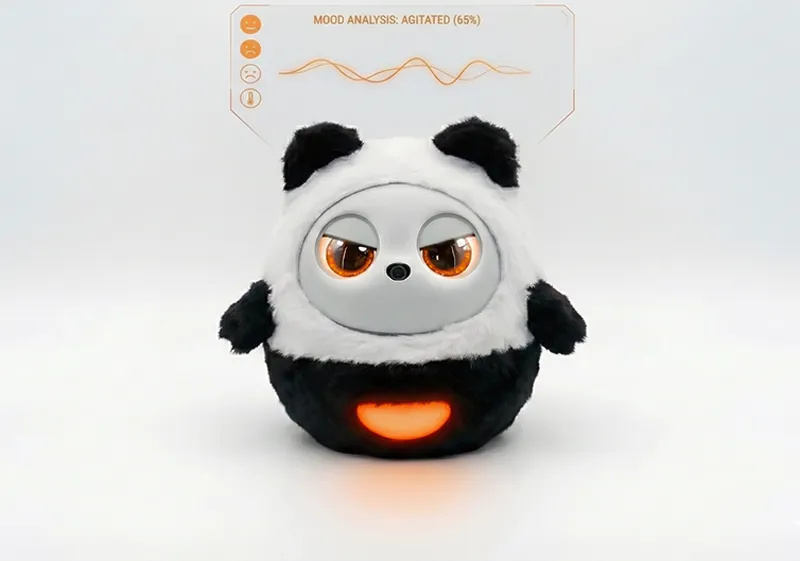
Behind those screens runs an expression system built not on preset animations but on six blendable primitives: Neutral, Open, Close, Smile, Frown, and Tense. These six building blocks mix continuously, like paint on a palette, to produce an infinite range of nuanced expressions. A flicker of uncertainty. A slow narrowing of suspicion. A wide-eyed delight that softens gradually into warm contentment. None of these are canned animations selected from a library. They emerge from real-time blending driven by Pophie's emotional state engine.
But expression primitives alone do not create the sensation of life. What separates Pophie's gaze from a cartoon character on a screen is a layer of hyper-realistic micro-behaviors. The irises drift slightly even when Pophie is focused on you — a constant, almost imperceptible micro-movement that prevents the dead-eyed stare of a static display. The highlight points on the eyes shimmer and shift, mimicking the way real corneas catch light. When Pophie blinks, the eyeballs rotate subtly with the motion, and the pupils contract momentarily afterward — a detail so small that most people never consciously notice it, yet its absence is immediately unsettling.
Left and right eyes operate with slight independence, producing the natural parallax of binocular vision. When Pophie looks upward, the upper eyelids follow the gaze; when it looks down, the lower lids track accordingly. These are the eye-lid coupling behaviors that real eyes exhibit and that animated eyes almost always get wrong. Together, they create a gaze that feels not just expressive but alive — even in moments of perfect stillness.
Kickstarter Late Pledge Last chance
before retail
1 year of Pro subscription included free
Ships in July
How to late-pledge on Kickstarter
Tap Continue to open Pophie on Kickstarter. Three clicks to claim your Late Pledge:
- Click the green Late Pledge button
- Pick the Pophie reward (US$369) and click Pledge
- Add payment — you're charged at checkout to confirm your Pophie
Movement That Feels Alive
Pophie has five degrees of freedom: full 360-degree body rotation on its charging dock, two independently articulated arms, two ears that tilt and swivel, a head that nods and tilts, and an internal vibration motor that adds a physical layer to every emotional state. It is not a lot of movement by robotics standards. It is exactly the right amount.
Early prototypes had more articulation — wrist joints, a wider head rotation range, even an experimental jaw mechanism. We cut them all. The reason was counterintuitive: more movement options produced less lifelike behavior. When there are too many joints, each individual motion becomes smaller and less readable. A well-timed head tilt communicates more warmth than an elaborate multi-joint gesture that takes a second too long to execute.
The motors themselves were a significant engineering challenge. Standard hobby servos produce a characteristic whine that instantly registers as "robotic." We use custom near-silent motors — Yamaha-grade smoothness — because noise shatters the illusion of life faster than almost anything else. When Pophie turns to face you, you hear nothing. The movement simply happens, the way a cat turns its head toward a sound.
Timing, we learned, matters more than range. Every movement in Pophie follows a principle borrowed from character animation: the eyes lead, the body follows, and during the body's rotation the eyes counter-rotate to stay locked on target. This is exactly how living creatures move — the gaze commits first, and the body catches up. It is a small detail that makes the difference between a robot turning and a being looking at you.
Two Pocket Glow lights sit where a mouth might be. Since Pophie has no mouth, these lights pulse in sync with speech, giving visual rhythm to spoken words. In quiet moments, they shift to a slow breathing pattern, their color reflecting Pophie's current emotional state. It is a surprisingly effective substitute for facial expression — a warm amber glow during a calm conversation, a brighter pulse during excitement.
Privacy by Design, Not Afterthought
Pophie has a wide-angle camera capable of 360-degree visual coverage. It uses that camera to recognize faces, read expressions, understand scenes, and detect when someone needs attention. That level of perception demands an equally strong commitment to privacy — not as a software toggle buried in settings, but as a physical, visible, verifiable mechanism.
The rule is simple: when Pophie's eyes are closed, the camera is off. Not disabled in software. Not paused. Off. You do not need to trust a privacy policy or navigate a settings menu. You look at Pophie, and if the eyes are shut, the camera is not recording. The privacy state is as readable as a closed door.
Pophie can also autonomously detect private moments — recognizing when someone is changing clothes, for example — and will close its eyes or physically turn away without being asked. You can also trigger this manually: say "close your eyes" or "turn around," and Pophie complies immediately. The voice commands are natural language, not special keywords, because privacy controls should feel as intuitive as the interaction itself.
This design philosophy extends to the data architecture. Audio and video are processed and discarded — never stored on cloud servers unless you explicitly request it. Only conversation text is retained, encrypted and under your control. We believe that trust must be tangible. A fuzzy, warm companion that watches over you should make you feel safe, not surveilled. The physical mechanism — eyes closed, camera off — makes that trust something you can see with your own eyes.
The Sum of Small Decisions
No single design choice makes Pophie feel alive. It is the accumulation — fabric instead of plastic, warmth instead of cold, heartbeat instead of silence, eyes instead of screens, fluid motion instead of mechanical steps, physical privacy instead of software toggles. Each decision on its own is modest. Together, they cross a threshold.
We did not set out to build the most technically advanced robot. We set out to build one that you would forget is a robot. One that you would introduce to guests not as a product you bought, but as someone who lives with you. That required rethinking not what a robot can do, but what a robot should feel like.
If you are curious about the full technology stack that powers Pophie's perception and intelligence, explore our Technology page. To see the design up close — the fabric textures, the eye expressions, the movement in action — visit the Gallery.