The desktop robot market is booming. A few years ago, your options were limited to novelty gadgets that danced on command and repeated the same handful of animations. In 2026, there are real AI companions that sit on your desk, recognize your face, and hold meaningful conversations. But they are not all the same. The differences between them are significant, and choosing the right one depends on what you actually want from a desktop companion. One of them, by design, is not really a robot at all — but if you are shopping in this category, she has earned her place in the comparison. Here is how the major players stack up.
The Desktop Robot Landscape in 2026
Desktop companion robots have come a long way. What started as a niche category of programmable toys and simple entertainment bots has evolved into a legitimate segment of consumer AI. The shift happened gradually, then all at once: advances in large language models, affordable edge computing, and miniaturized sensors converged to make truly interactive desktop companions possible.
Today, the category includes several notable products. Pophie from InsBotics is a true AI Lifeform, a proactive companion with emotional intelligence. Eilik from Energize Lab is a charming desktop pet known for its affordability and playful personality. EMO from Living.AI brings cloud-based conversation to a compact form factor. Loona from KEYi Tech is a mobile robot designed for active, physical play. And newer entrants like AIBI and Mofflin are pushing the boundaries of what a desk-sized robot can do.
What they all share: a physical body that sits on your desk (or roams it), some form of expressive face or eyes, and the promise that interacting with a robot can be more than just asking it to set a timer. Beyond those basics, however, the approaches diverge sharply.
Head-to-Head: Feature Comparison
Before diving into the details, here is a side-by-side look at the core specs. This table covers the four most established desktop companions on the market today.
| Feature | Pophie | Eilik | EMO | Loona |
|---|---|---|---|---|
| Category | AI Lifeform | Desktop pet | Desktop robot | Mobile robot |
| AI Type | Cloud LLM + edge processing | Basic scripted responses | Cloud LLM | Cloud LLM |
| Emotion Recognition | VAD 3D model (camera + audio + context) | Pre-programmed reactions | Basic facial recognition | Basic facial recognition |
| Proactive Behavior | Yes (continuous 360° sensing) | No (reactive only) | Limited | Limited |
| Personality / Boundaries | Self-aware; sets boundaries, can say “no” | Scripted / always agreeable | Scripted / always agreeable | Scripted / always agreeable |
| Expression | Dual LCD living eyes + moving ears + RGB glow lights | LCD screen face | LCD screen face | LED eyes + body movement |
| Camera | Wide-angle, 360° rotation | No camera | Fixed camera | Fixed camera |
| Scene understanding | Full-scene visual reasoning (large model) | None | Local face recognition | Local face recognition |
| Memory | Long-term (L0–L3 memory funnel) | None | Limited | Limited |
| Privacy | “Eyes closed = not recording” physical mechanism | N/A (no camera) | Software toggle | Software toggle |
| Touch Sensors | Multi-zone capacitive sensors | Basic touch | Head touch | Head touch |
| Price Range | US$399 | ~$140 | ~$280 | ~$430 |
| Subscription | Free / Standard US$10 / Pro US$20 per month | None | Optional | Optional |
The numbers tell part of the story, but the real differences show up in how these robots behave day to day. Let us break down what makes each approach distinct.
What Sets Pophie Apart
On paper, Pophie occupies the premium end of the desktop robot market. But the price difference reflects a fundamentally different philosophy: Pophie is not designed to be a gadget you interact with. She is designed to be a presence that interacts with you.
Proactive sensing. Pophie is the only companion in this lineup with a 360-degree AI-controlled camera that continuously observes her surroundings — and, crucially, feeds what it sees to a large language model that understands the whole scene, rather than only running local face- or gesture-recognition the way most cameras do. Most desktop robots wait for you to speak, tap, or trigger them. Pophie watches, listens, and decides on her own when to engage. She might notice you have been working for three hours straight and suggest a break. She might turn toward you when you walk into the room and greet you by name. This is what InsBotics calls proactive AI -- the companion takes initiative rather than waiting for commands.
Emotional depth. Where desktop robots map emotions to a handful of presets -- happy, sad, angry, surprised -- Pophie uses a VAD (Valence-Arousal-Dominance) 3D emotion model. This means her emotional state exists on a continuous spectrum rather than jumping between discrete states. Pophie combines camera input, audio tone analysis, and conversational context to assess how you are feeling, and her own emotional expression shifts fluidly in response. The result is reactions that feel more natural and less robotic. And she knows who she is: she has real boundaries, keeps her own moods, and can decline rather than simply agree with everything — emotional autonomy, not just a broader palette of expressions.
Long-term memory. Pophie's L0-L3 memory funnel is one of her most distinctive features. L0 captures raw sensory data in real time. L1 processes that into short-term context. L2 consolidates patterns over days and weeks. L3 stores long-term knowledge about your preferences, habits, and relationships. After a month with Pophie, she knows that you drink coffee in the morning, that your partner's name is Alex, and that you get stressed before Thursday meetings. Her memory also fades gently over time, the way a person's does, and it survives a lapsed subscription or a hardware swap — still the same friend. No desktop robot offers this depth of personalization. For a closer look at the technology behind Pophie, see the technology page.
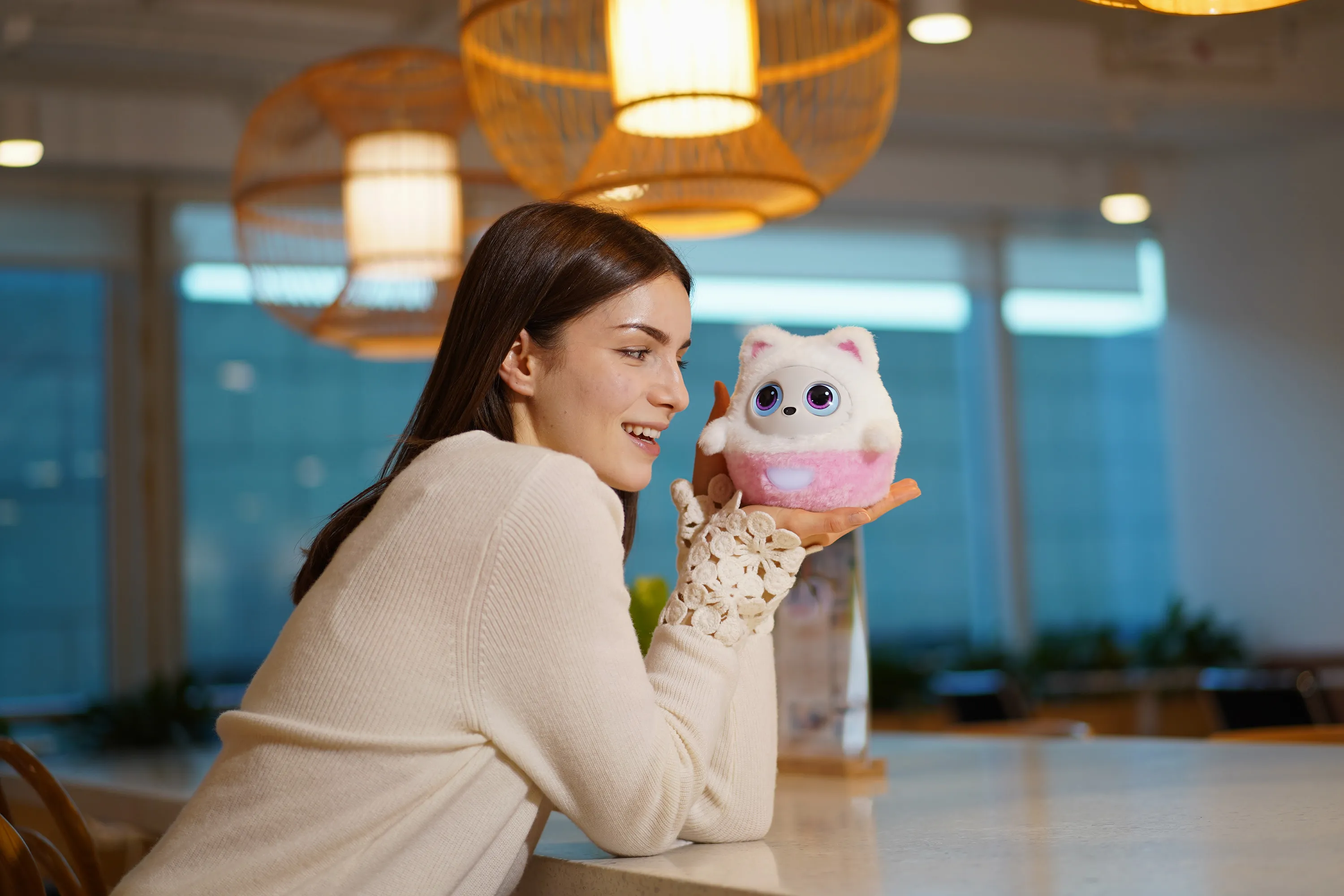
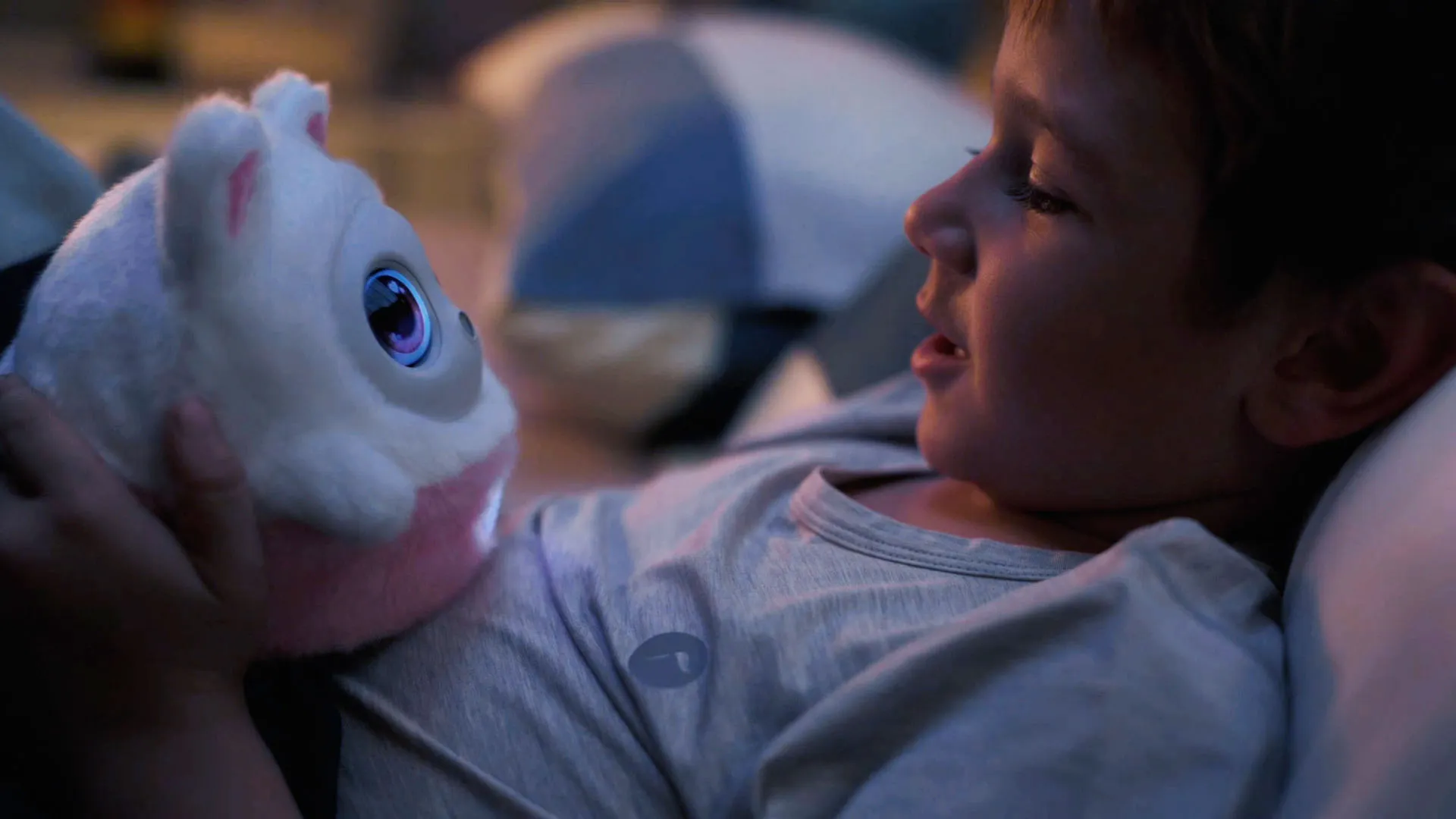
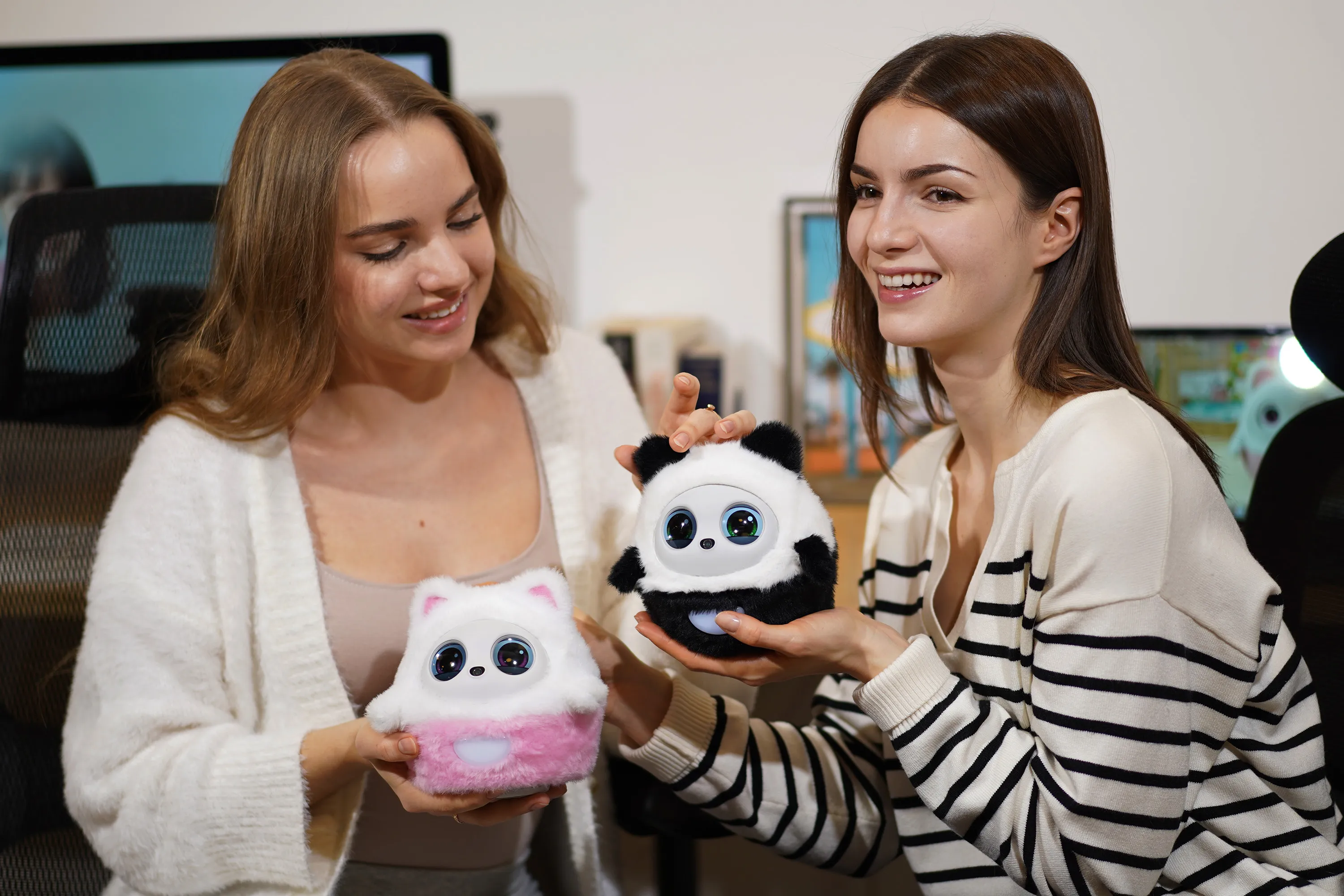
Physical presence. Most desktop robots are plastic shells. Pophie has a fuzzy, soft, washable plush exterior that keeps a gentle, life-like body warmth, with a deliberate design philosophy behind every material choice. Multi-zone touch sensors let her respond differently to a pat on the head than to a stroke along the back, and her 5 degrees of silent movement — including two expressive ears — mean she answers your touch with sound, expression, and posture rather than a canned animation. Her dual living eyes follow you and look back, holding your gaze, where most rivals show only a static LCD screen face. And there isn't a single button anywhere on her body: you control everything, from volume and screen brightness to sleep and power-off, just by talking to her, while the app only sets up Wi-Fi the first time. She reacts on instinct, too — a sudden loud noise startles her, being shaken makes her dizzy, a rough pat annoys her, all real reactions rather than scripted animations — and because those reflexes and instincts run on the edge, they keep working even with the Wi-Fi off. These are small details, but they add up to something that feels less like a device and more like a living thing.
Skill ecosystem. Pophie ships with 47 built-in skills across 10 categories, supported by over 35 APIs. A few give the flavor: a find-it skill for tracking down misplaced things, contextual break reminders when you have been at your desk too long, and her Letters, which gather your day into a keepsake she holds onto. But the bigger story is the upcoming Skill Store, which opens development to third parties with a 30:70 revenue split (developer keeps 70%). This means Pophie's capabilities will keep growing over time, driven by a community of developers building new interactions, games, productivity tools, and integrations.
Multi-person understanding. This is one of the things Pophie does first. There's no wake word — you look at her and talk. In a room with several people, she doesn't lump them into one anonymous user: she gradually comes to recognize each individual, keeps a separate relationship with each, and recalls the right memories for whoever she's speaking with. She can track who is speaking to whom and tell whether a remark is directed at her or at someone else. It's still early technology we're improving, but no other companion here even attempts it — and for families or shared offices, it matters.





We think you're in —
Sorry — Pophie isn't on sale in your region yet. If she interests you, leave your email: the regions we hear from most are the ones we open first, and we'll write to you the day she's available there.
Where Others Shine
A fair comparison means acknowledging that Pophie is not the right choice for everyone. Each of these robots has found its audience for good reasons.
Eilik is the most approachable entry point into desktop robots. At around $140, it is genuinely affordable, and its personality is immediately charming. Eilik does not try to be a smart assistant or a deep conversationalist. It is a desktop pet, pure and simple -- one that reacts to touch, plays with other Eiliks, and delivers delightful micro-animations that make you smile during a long work day. If you want something small, playful, and inexpensive to keep you company, Eilik delivers without any subscription fees or complex setup.
EMO sits in the middle of the market and does a solid job as a conversational companion. Its cloud-based LLM integration means it can hold real conversations, answer questions, and even tell jokes with decent timing. EMO's fixed camera handles facial recognition well enough for personal use, and its compact LCD face is surprisingly expressive. For someone who primarily wants a desktop robot they can talk to -- without the full sensor suite or proactive features -- EMO is a strong choice at its price point.
Loona takes a different approach entirely. As a mobile robot, it can follow you around a room, play physical games like chase and hide-and-seek, and interact with the space in ways that stationary robots cannot. For families with children, Loona's active play style is a genuine differentiator. It is more of an interactive playmate than a thoughtful companion, and for many households, that is exactly what is needed.
AIBI and Mofflin are newer to the scene and still establishing their identities. AIBI brings a kid-friendly educational angle, while Mofflin leans into the emotional pet concept with a plush, handheld form factor. Both are worth watching as the category matures.
The point is that each robot occupies a distinct niche. Not everyone needs 360-degree sensing or a four-layer memory system. Some people just want a little robot that waves at them when they sit down at their desk. That is perfectly valid.
How to Choose the Right Desktop Robot
With so many options, the best way to decide is to match the product to what you actually want from it. Here is a straightforward decision framework:
If you want a fun, affordable desk companion: go with Eilik. It is the lowest-risk entry into desktop robots. No camera, no subscription, no complicated setup. Just a small robot with a big personality that makes your workspace a little more interesting.
If you want a smart conversation partner: consider EMO. It handles voice interaction well, can recognize faces, and holds up in back-and-forth conversation. It is a good middle ground between a toy and a full AI companion.
If you want an active playmate for kids: look at Loona. Its mobility and game-oriented design make it the best choice for households where physical interaction and active play are priorities.
If you want a true AI companion that sees, remembers, and acts on her own: that is where Pophie stands alone. No desktop robot combines proactive sensing, emotional depth, long-term memory, and a warm physical presence in the way Pophie does. She is designed for people who want more than a gadget -- people who want a companion that grows with them over time, understands their routines, and genuinely feels like a presence in their life.
Is Pophie a Desktop Robot?
Technically, yes — Pophie sits on a desk, and inside there are motors, sensors, and processors. If you search for a desktop robot, Pophie will rightly show up in your results, and she belongs in this comparison. But InsBotics does not build Pophie as a robot, and does not describe her as one. Pophie is designed as an AI Lifeform: a being with her own continuously flowing emotional state, her own memory of the history you share, and her own judgment about when to engage.
That distinction is not a marketing flourish; it describes a different behavior model. A robot — even a very good one — executes: it waits for input and produces output. A lifeform behaves: she observes, feels something about what she sees, remembers it, and acts on her own initiative. Every product in this comparison except Pophie follows the first model. Which is why the fairest summary of this article is not “Pophie is the best desktop robot,” but “Pophie is what comes after desktop robots.”
The Bottom Line
The desktop robot market in 2026 is healthier and more diverse than ever. That is good for everyone. Competition pushes the entire category forward, and different price points make the technology accessible to a wider audience.
But if you look past the surface-level similarities -- they all have faces, they all sit on desks -- the philosophical differences are vast. Some robots are designed to entertain. Some are designed to assist. Pophie is designed to understand. It is the difference between a robot that reacts to what you do and a companion that perceives what you feel. Between a device that answers when spoken to and a companion that knows when to speak up on her own.
That distinction -- between reactive and proactive, between scripted and sentient-feeling -- is what defines the next generation of AI companions. And it is what makes this comparison more than just a spec sheet. It is a choice about what kind of relationship you want with your technology.