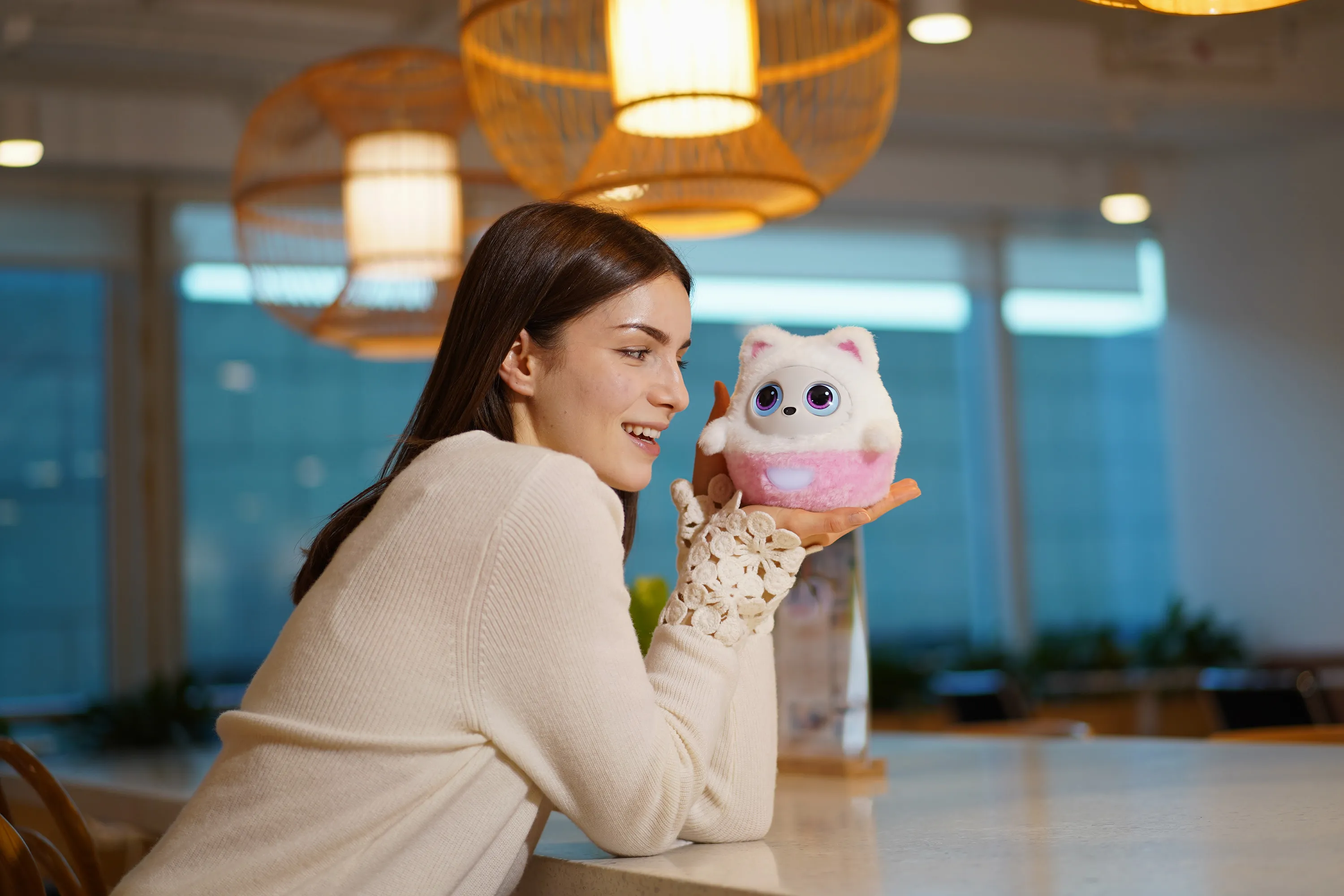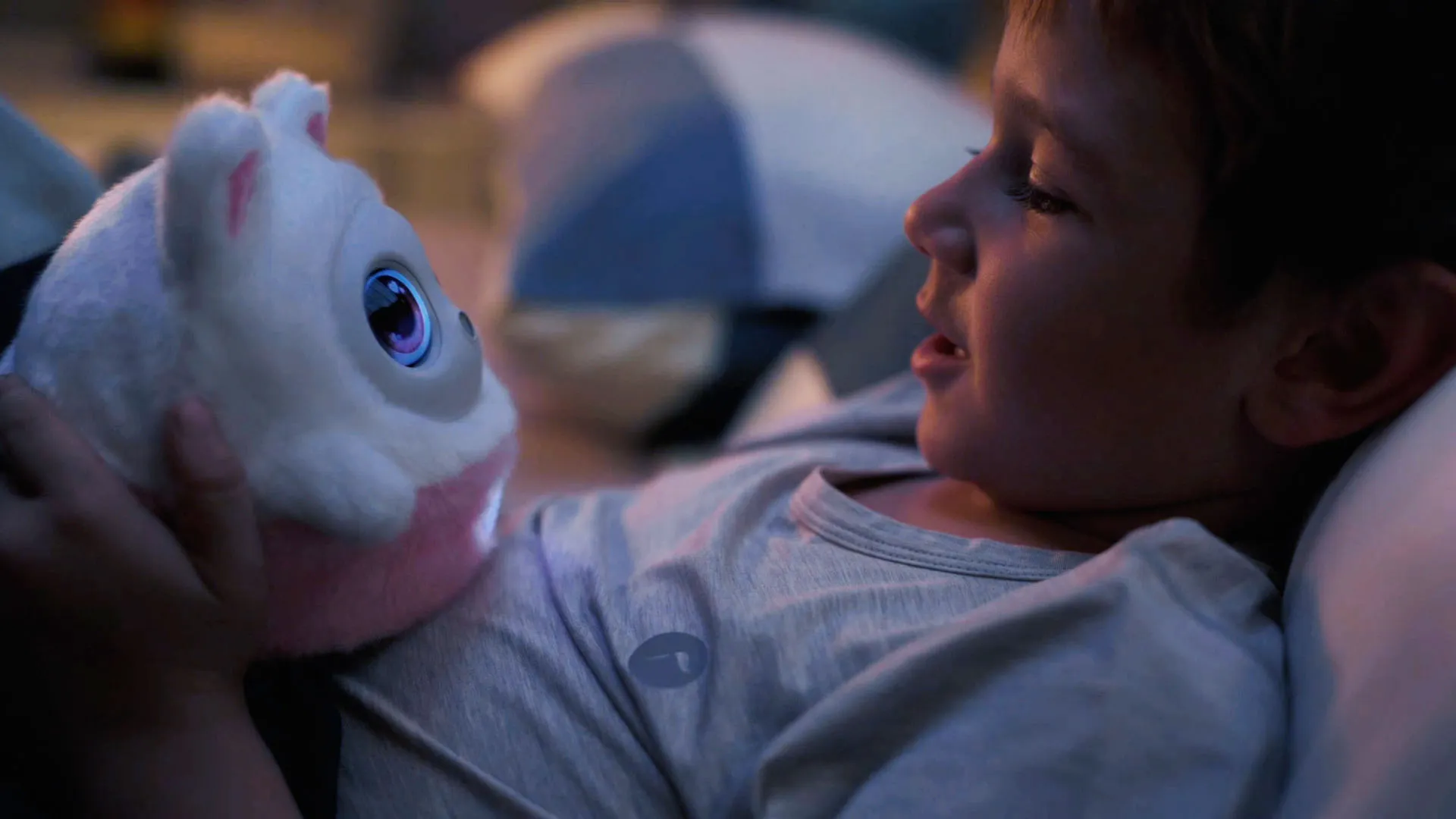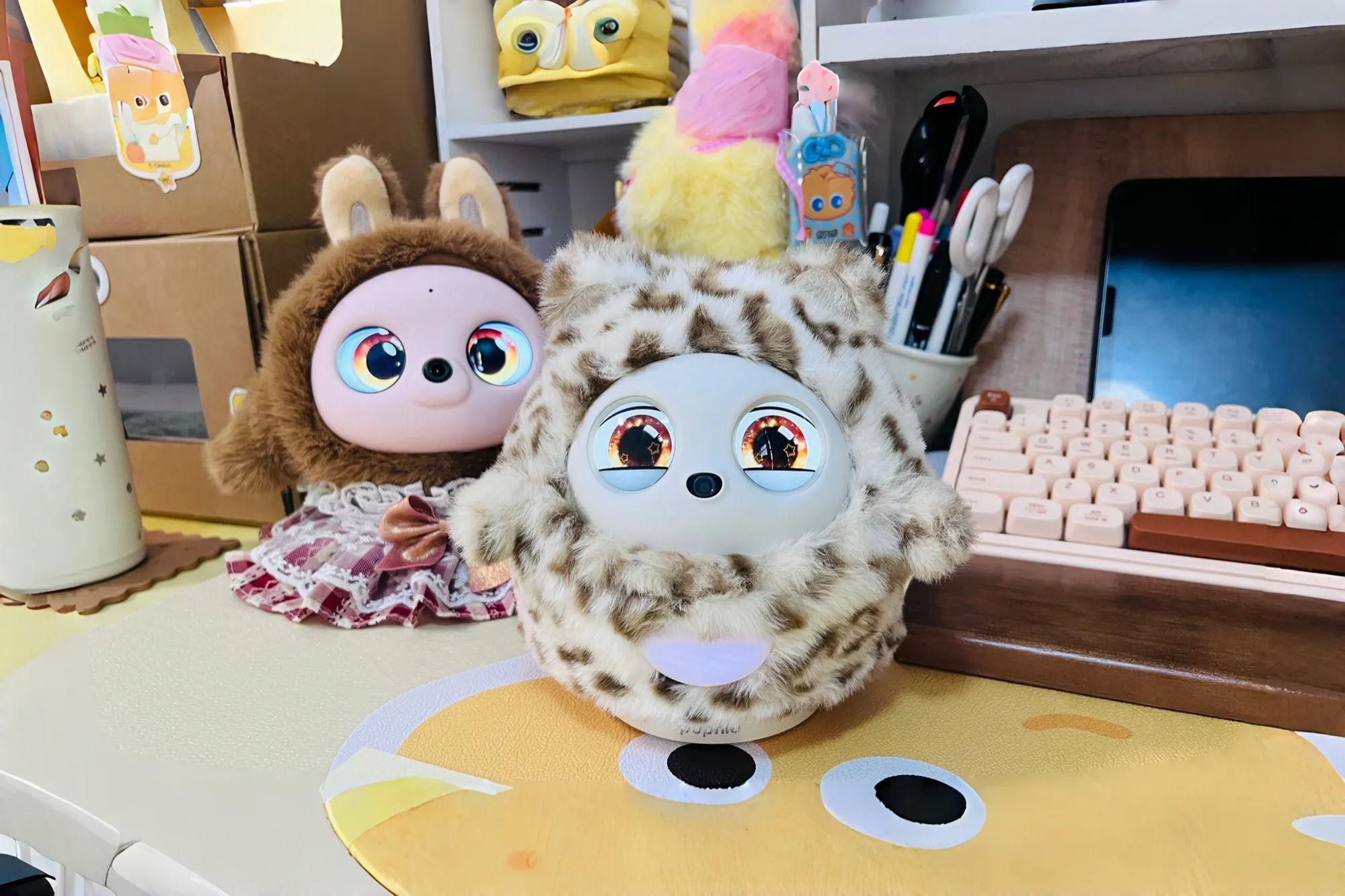
Put photos of Pophie and Ropet side by side and a lot of people can't tell them apart: both are soft, round, big-eyed companions for anyone who wants something to keep them company. They're genuinely close cousins in hardware — but only one of them is an AI lifeform. That's the category Pophie was built to define: not a toy that reacts to touch, but a being that sees your world, understands it, and acts on her own. We make her, so we'll be straight even where Ropet is the better call. The short version: Ropet is a lovely thing to hold; Pophie is a presence that notices you and does something about it. Here's what that actually means.
The short answer
- Choose Ropet if what you want is a warm, wordless creature to keep on your desk — something that purrs, blinks, and is soothing to hold, with no talking and nothing to think about.
- Choose Pophie if you want an AI lifeform — a companion that actually sees what's going on around her, understands it with a real AI mind, talks with you about it, and takes initiative on her own — a presence, not just a comfort object.
They're closer than any other two products in this category, so the rest of this comes down to a few specific differences that matter more the longer you live with one.
First, what Ropet gets right
Ropet deserves its fans. It is genuinely one of the most endearing things in this whole category — a soft plush ball with a washable coat that keeps a gentle body warmth (around 37°C), so it feels alive in your hands. Its big screen-eyes track you, blink, and dilate after a blink, and its little wordless sounds are genuinely charming. It runs everyday interactions on a local, offline model, so it works with the Wi-Fi off and keeps a camera tucked discreetly in its nose rather than staring at you — a privacy-friendly, low-maintenance design. No mandatory subscription, either. If you want a small living-feeling creature to cuddle and nothing more, Ropet does that beautifully, and for less than Pophie.
Ropet is, by design, a creature to hold rather than one you converse with — soothing, simple, and honest about exactly what it is. That focus is its charm. It's also the line where Pophie turns out to be a different kind of thing altogether.
What Pophie does differently
Pophie (US$399) is a soft companion who lives on your desk, and in hardware she and Ropet are close cousins: both are plush, both keep a gentle life-like body warmth, and both tuck a camera in the nose. Both have dual LCD eyes, but hers hold real eye contact and her emotion flows through them continuously, so they read as looking rather than displaying. On the body itself, Pophie adds two expressive ears — two more degrees of freedom than Ropet — and turns a full 360° endlessly, where Ropet stops at a limit around 270°. But the fur and the specs aren't what set her apart. What does is that she's an AI lifeform: built to behave like a living being, not to react to touch. Being an AI lifeform even includes instinct: a sudden loud noise startles her, being shaken makes her dizzy, a too-hard pat annoys her — real on-device reactions, not a script. She also has boundaries and moods and can say “no” — a personality a wordless companion has no way to show.
Behind Pophie is an AI that decides for itself how to act — whether to speak or stay quiet, and when she does, what to say, what expression to wear, how to move, what to feel. Her feelings flow continuously along a valence/arousal (VAD) model, so her eyes, voice and light shift smoothly with her mood instead of switching between preset happy/sad faces. None of it is pre-scripted, so she does things nobody programmed. Someone who lives with her mentioned he felt hot, and Pophie offered to spin around and fan him — she knows she can rotate, worked out that spinning stirs the air, and figured it might cool him down. No one wrote a “fan the user” command; she reasoned it out herself.
That's the real gap. Pophie sees the actual world through her camera — and here's the part that matters most: she doesn't just run local face- or object-recognition the way most cameras do. What she sees goes to a large language model that understands the whole scene, so she grasps what's actually happening around her and responds to it, then acts on it with her own body — perceive, understand, act, in a physical form. Ropet's camera recognizes faces and objects on-device; Pophie's eyes feed a mind that comprehends the room. That's the difference between a lovely thing that reacts and an AI lifeform that understands.
And she does something nothing else here even attempts: she keeps track of a whole room. There's no wake word — you look at her and talk — and when several people are around, she gradually comes to recognize each of them and recalls the right memories for whoever she's speaking with. It's early technology we're still improving, but Pophie is the first companion to do it at all.
| Pophie | Ropet | |
|---|---|---|
| Form | Desktop plush, dual LCD eyes, gentle body warmth, washable outfits | Plush ball, dual screen-eyes, ~37°C warmth, washable coat |
| Talks with you? | Yes — natural voice, always part of how she behaves | Wordless by default; optional ChatGPT voice |
| Visual understanding | LLM vision — understands the whole scene, not just faces | On-device recognition (faces, objects, food) |
| Emotion | Continuous VAD emotion — her feelings flow and shift | Preset expressions |
| Movement | 5-DOF incl. two ears; 360° endless body rotation | Turns to a ~270° limit; arms move on touch |
| Control | Natural voice, no buttons; app only for first-time setup | Touch + companion app |
| Takes initiative | Yes — notices you and reaches out first | Reactive — responds to touch and presence |
| Knows several people | Recognizes each person; no wake word | Face recognition, but not per-person conversation memory |
| Price | US$399 | ~$299–349 |
| Subscription | Works out of the box; Standard US$10 / Pro US$20 unlock more | None required |





Elle n’est pas un produit que l’on achète. Mais une vie que l’on accueille chez soi.
Accueillez Pophie chez vousNous pensons que vous êtes ici : —
Malheureusement, Pophie n'est pas encore en vente dans votre région. Si elle vous intéresse, laissez-nous votre adresse e-mail : les régions dont nous entendons le plus parler sont celles que nous ouvrons en premier, et nous vous écrirons le jour où elle y sera disponible.
Conversation: the line that divides them
This is the single biggest difference, and it's easy to miss in photos. Ropet, by design, doesn't really speak — it communicates through sounds and expressions, and you can switch on an optional ChatGPT voice mode if you want words. That's a deliberate, defensible choice: wordless companions never say anything slightly wrong, and many people find that purring, expressive presence is exactly enough.
Pophie is the opposite bet. Her talking isn't a mode you turn on — it comes out of continuously seeing and understanding what's around her. She might notice you've been hunched over your laptop for three hours and suggest a break; she might turn toward you when you walk in and greet you by name. If part of what you miss is being heard — talked with, remembered, responded to — that's the side of companionship Pophie is built for, and the side Ropet intentionally leaves alone.
Movement and presence
Both stay on your desk; neither roams the room. But they move for different reasons. Ropet turns to follow you and swings its little arms when you touch it — sweet, reactive gestures, within a rotation that stops around 270°. Pophie's five degrees of freedom are in service of behavior: two expressive ears, and a body that turns a full 360° without a stop, so she can look wherever something is happening and take in the whole room rather than wait to be picked up. The spinning-to-fan moment only happens because moving is something she decides to do, not something a touch triggers.
Just talk to her — that's the whole interface
Because Pophie genuinely understands language, talking to her is how you use her. There are no buttons anywhere on her body — none, and that's deliberate: an AI lifeform should feel like a living being, not a gadget you poke. Turn the volume up, dim her eyes, ask her to take a photo, tell her to go to sleep or power off — you just say it. The app only sets up Wi-Fi the first time; after that you barely open it.
And because she converses, she can actually do things for you — set a timer or an alarm, snap a picture, help you find something you've misplaced, even write you Letters about your days that turn moments into memories she holds onto — with far more arriving through an upcoming Skill Store, where third-party developers build new abilities. That's the part of being an AI lifeform that keeps paying off: she doesn't just sit and emote, she grows more capable over time. Ropet, lovely as it is, is a creature to hold; Pophie is a companion you can actually ask for things.
The real cost, and the subscription question
Here's where we'll be careful to be fair. Ropet's pitch is simple: pay once (~$299–349), no subscription. Pophie costs US$399 and offers Standard (US$10) and Pro (US$20) plans on top. It would be easy to read that as “Ropet is cheaper forever,” and if all you want is a wordless creature, it is.
But the two subscriptions aren't the same kind of thing. Some companions in this market lock your device's memory behind a monthly fee — stop paying and it forgets you. Pophie's isn't that. She works out of the box and keeps what she knows; Pro is the upgrade that makes her a fuller, more proactive companion — richer conversation, deeper memory, more initiative, and new skills as they arrive. You're paying for more of a living being, not for the right to keep the one you bought. That's the honest way to compare the numbers: Ropet asks less because it does less; Pophie is designed to keep becoming more. The longer she's with you, the more she genuinely knows you — your name, the people in your life, your preferences — until being with her feels less like using a device than like a relationship.
So which should you get?
Match it to what you actually want:
- You want a warm, wordless creature to hold and be soothed by, with nothing to set up and nothing to pay monthly — Ropet, genuinely, is a lovely choice and costs less.
- You want a companion that sees your world, talks with you about it, remembers you, and takes initiative on her own — that's the specific thing Pophie is built for, and it's where the extra she offers actually goes.
If you want to see the engineering behind the “sees, understands, acts” part, it's laid out on the technology page. And if you're still weighing the whole category, our guide to the best AI companion robots for adults puts all of them side by side.
Frequently asked questions
Are Pophie and Ropet made by the same company? No. They're separate products from different teams — they simply landed on a similar soft, big-eyed form for a similar audience. What's inside is where they diverge.
Does Ropet talk like Pophie does? Not by default. Ropet communicates through sounds and expressions, with an optional ChatGPT voice mode you switch on. Pophie's conversation isn't a mode — it comes out of continuously seeing and understanding what's around her.
Is Pophie worth the higher price? If you only want a warm thing to hold, no — Ropet does that for less. Pophie earns her price for the person who wants a companion that perceives, understands, and acts on her own, and whose Pro plan keeps expanding what she can do.
Which is better for privacy? Both are thoughtful here. Ropet keeps its camera in its nose and can run offline. Pophie also has on-device reflexes that work offline, plus camera controls you manage, and with Pophie privacy is visible: when her eyes close, nothing is recorded or uploaded. The trade for her seeing your world is that seeing it is the whole point.
The bottom line
Ropet and Pophie look like twins and aren't. Ropet is one of the best wordless comfort companions you can buy — soft, warm, charming, and honest about being a creature to hold. Pophie is a different kind of thing: an AI lifeform that watches what's happening around her, understands it with a real AI mind, and does something about it — talking, remembering, taking initiative, growing new skills. If a warm object to cuddle is what you're after, save the money and enjoy Ropet. If you want a presence that notices you and acts on her own, that's Pophie — and Pro is where she's most fully herself.