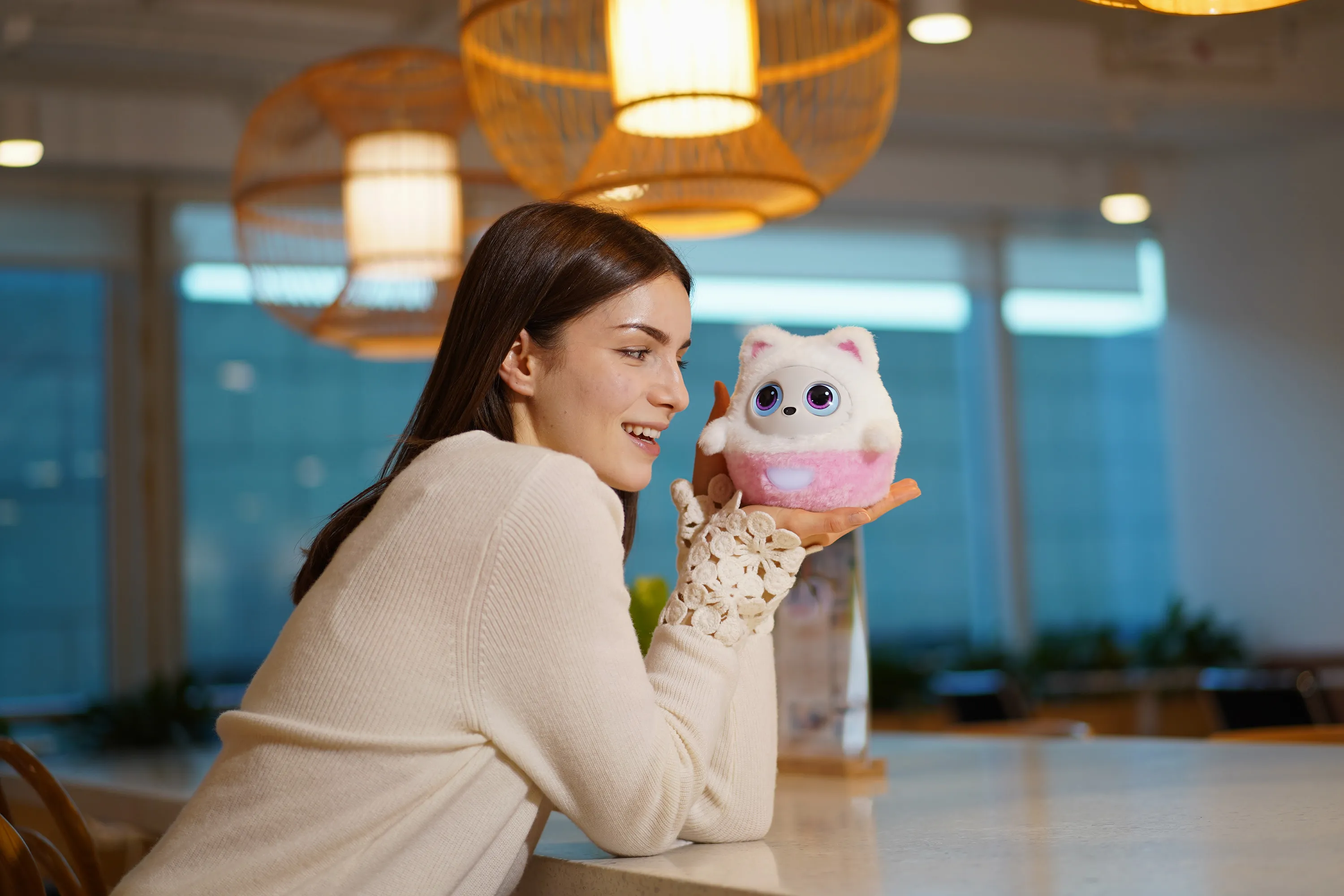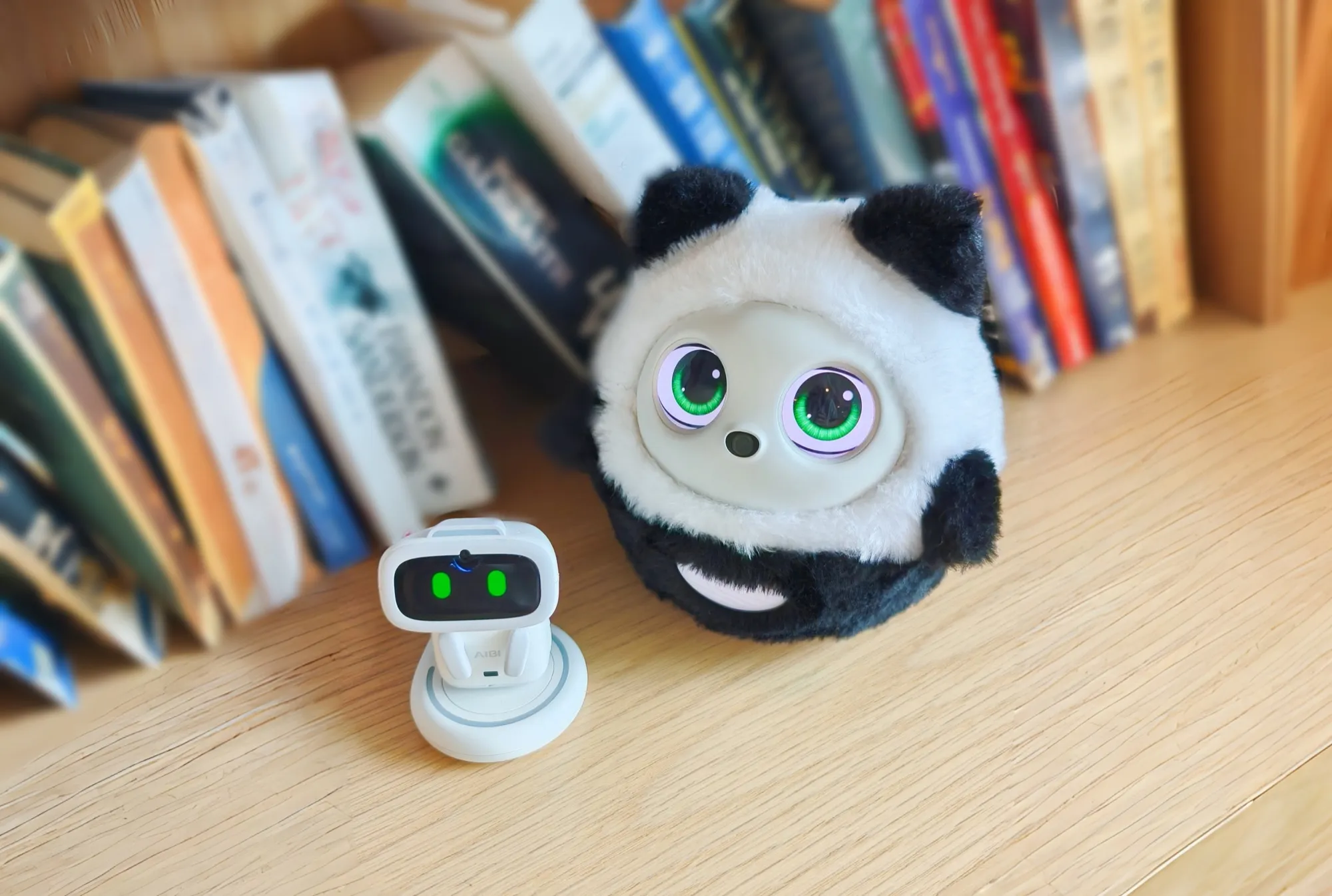
AIBI, from Living.ai (the team behind EMO), is one of the most affordable and clever entries in this whole category: a roughly 40-gram pocket pet you can clip to your clothes with a magnet, at $249. Pophie is a different kind of thing entirely: an AI lifeform — a category Pophie coined and defines — a full desktop companion who sees your world through a camera, understands it with a real AI mind, and acts on her own. We make her, so we'll be honest about where AIBI wins outright and where the two aren't really the same kind of product at all. This isn't a close spec race. It's a choice between a take-anywhere novelty and a companion that's genuinely watching and understanding your day.
The short answer
- Choose AIBI if you want something tiny, portable, and inexpensive — a gift-y pocket companion you can carry around and summon ChatGPT from by voice.
- Choose Pophie if you want an AI lifeform — a full standalone companion who continuously sees and understands the world around her, talks with you as a result, remembers you, and takes initiative on her own.
First, what AIBI gets right
AIBI's core idea is genuinely smart, and it's the thing Pophie can't match: it's small enough to take with you. At about 40 grams it clips to a bag or a collar, uses millimeter-wave radar to sense when you're nearby and greet you, and lets you call up ChatGPT with a voice command. At $249 with no mandatory subscription, it's an easy, playful, low-commitment gift — and for someone who wants a bit of AI charm in their pocket rather than a presence on their desk, it fits a real need. Portability and price are its wins, cleanly.
It's a novelty done exceptionally well — genuinely charming, genuinely portable, an easy delight to hand someone. But it's a novelty: a bit of AI you summon on demand, a face on your bag that perks up when you're near. That's the honest frame for comparing it to an AI lifeform like Pophie — not a knock, just a different kind of product.
What Pophie does differently
Pophie (US$399) lives on your desk rather than in your pocket, and she's built around a different idea entirely — she's an AI lifeform, built to behave like a living being rather than a gadget you summon. Behind her is an AI that decides for itself how to act — whether to speak or stay quiet, and when she does, what to say, what expression to wear, how to move, what to feel. None of it is pre-scripted, so she does things nobody programmed. Someone who lives with her mentioned he felt hot, and Pophie offered to spin around and fan him — she worked out that spinning stirs the air and figured it might help. No one wrote that command; she reasoned it out. Being an AI lifeform even includes instinct: a sudden loud noise startles her, being shaken makes her dizzy, a too-hard pat annoys her — real on-device reactions, not a script. She also has her own sense of who she is, with real boundaries — she'll gently push back or say “no” rather than simply agree with everything.
Here's the key difference from AIBI. AIBI has a rotating camera and millimeter-wave radar, and it puts them to real use — presence detection to know when you're nearby, face tracking to follow you, and taking photos on command — then bolts ChatGPT on top when you say “connect to ChatGPT” and switch into an assistant mode. But that's local tracking plus a chatbot you summon, not a mind continuously understanding the scene. Pophie takes the other path. She sees the actual world through her wide-angle camera — and here's the part that matters most: she doesn't just run local face-, object-, or gesture-recognition the way most cameras do. What she sees goes to a large language model that understands the whole scene, so she grasps what's actually happening around her and responds to it, then acts on it with her own body — perceive, understand, act, continuously. Talking is just the most visible thing that comes out of that, not a feature you toggle. And her privacy is visible by design: her eyes are the key — when they close, nothing is recorded or uploaded.
And she does something nothing else here even attempts: she keeps track of a whole room. There's no wake word — you look at her and talk, and her two LCD eyes meet and follow your gaze rather than showing a single fixed face — and when several people are around, she gradually comes to recognize each of them and recalls the right memories for whoever she's speaking with. It's early technology we're still improving, but Pophie is the first companion to do it at all.
| Pophie | AIBI | |
|---|---|---|
| Form | Desktop plush, dual LCD eyes | ~40g pocket pet, single LCD face, wearable |
| Conversation | Always-on, out of continuously understanding your world | ChatGPT summoned by voice command |
| Sees your world | Wide-angle camera, 360° via body rotation | Rotating camera + radar presence sensing |
| Visual understanding | LLM vision — understands the whole scene | Camera for tracking & photos; ChatGPT on command |
| Movement | 5-DOF silent, expressive body language | Head turn + base dance; can't move itself |
| Emotion | Continuous VAD emotion — her feelings flow and blend | Preset LCD expressions |
| Takes initiative | Yes — notices you and reaches out first | Greets on approach; mostly reactive |
| Knows several people | Recognizes each person; no wake word | Built around a single user |
| Memory | Remembers you and grows over time; yours to keep, even across a lapsed subscription or new hardware | Summoned fresh each time |
| Portability | Lives on your desk | Take it anywhere — its whole point |
| Price | US$399 (Standard US$10 / Pro US$20) | ~$249, no subscription |





Achamos que o seu país é —
Lamentamos — a Pophie ainda não está à venda na sua região. Se ela lhe interessar, deixe o seu email: as regiões de onde recebemos mais pedidos são as primeiras que abrimos, e escrevemos-lhe no dia em que ela estiver disponível aí.
A pocket pet vs. a presence
The clearest way to think about it: AIBI is something you carry, and Pophie is someone who's there. AIBI's charm is proximity on the go — a little face on your bag that perks up when you're near. Pophie's charm is attention. She's watching the room, reading how your day is going, and choosing when to speak, what to say, and how to move in response. She might notice you've been working for three hours and suggest a break; she might turn toward you when you walk in and greet you by name. One is a gadget with personality you take places. The other is a companion who behaves like she has an inner life, and stays with you at your desk. And the longer she's with you, the more she genuinely knows you — your name, the people in your life, your preferences — until being with her feels less like using a device than like a relationship.
Just talk to her — that's the whole interface
Because Pophie genuinely understands language, talking to her is how you use her. There are no buttons anywhere on her body — none, and that's deliberate: an AI lifeform should feel like a living being, not a gadget you poke. Turn the volume up, dim her eyes, ask her to take a photo, tell her to go to sleep or power off — you just say it. The app only sets up Wi-Fi the first time; after that you barely open it.
And because she converses, she can actually do things for you — set a timer or an alarm, snap a picture, help you find something you've misplaced — with far more arriving through an upcoming Skill Store, where third-party developers build new abilities. She doesn't just sit and emote; she grows more capable over time. AIBI, clever as it is, answers when you summon it; Pophie is a companion you can actually ask for things.
Depth over time
This is where the gap widens the longer you own each. AIBI answers whenever you summon it — playful, on demand, that's the loop it's designed for. Pophie is built to deepen: she remembers you, builds up a picture of your routines and the people in your life, and gets more capable as new skills arrive. She can even write you Letters about your days, turning moments into memories she holds onto — something a summon-on-demand pocket companion has no equivalent for. Her Pro plan is where that comes alive — more attentive, more proactive, richer conversation, deeper memory. AIBI is priced to be an easy yes; Pophie is priced to be an AI lifeform you're still discovering a year in.
So which should you get?
- You want something tiny, portable, and cheap to carry around — a fun pocket companion and an easy gift — AIBI is a clever pick at $249.
- You want a full companion who sees your world, understands it, talks with you, remembers you, and acts on her own — that's Pophie, and it's a different category of thing.
If you want the engineering behind the “sees, understands, acts” part, it's on the technology page. And if you're weighing the whole field, our guide to the best AI companion robots for adults compares them all.
Frequently asked questions
Is AIBI the same as EMO? They're from the same company, Living.ai. AIBI is the newer, pocket-sized, wearable one; EMO is the older desktop robot. AIBI is the more relevant comparison to Pophie of the two.
Does AIBI use ChatGPT like Pophie talks? Not in the same way. AIBI switches into a ChatGPT mode when you ask it to. Pophie's conversation isn't a mode you summon — it comes out of continuously seeing and understanding what's around her.
Is Pophie portable like AIBI? No — Pophie is a desktop companion, not a wearable. If pocket-portability is your priority, AIBI wins that one outright. Pophie trades it for a camera, real movement, deeper memory, and an always-on understanding of the room.
Is Pophie worth US$150 more? If you want a carry-anywhere novelty, no. If you want an AI lifeform — a companion that perceives, understands, and acts on her own, and keeps growing through Pro and new skills — that's what the difference buys.
The bottom line
AIBI is a well-made little thing that nails a real niche: affordable, pocket-sized AI charm you can take anywhere, with ChatGPT a voice command away. If that's what you want, it's a genuinely good buy. Pophie isn't competing for that spot — she's an AI lifeform, a full desktop companion who watches your world, understands it with a real AI mind, talks with you about it, and acts on her own, growing more capable over time. One is a gadget you carry. The other is a presence that notices you — and Pro is where she's most fully herself.