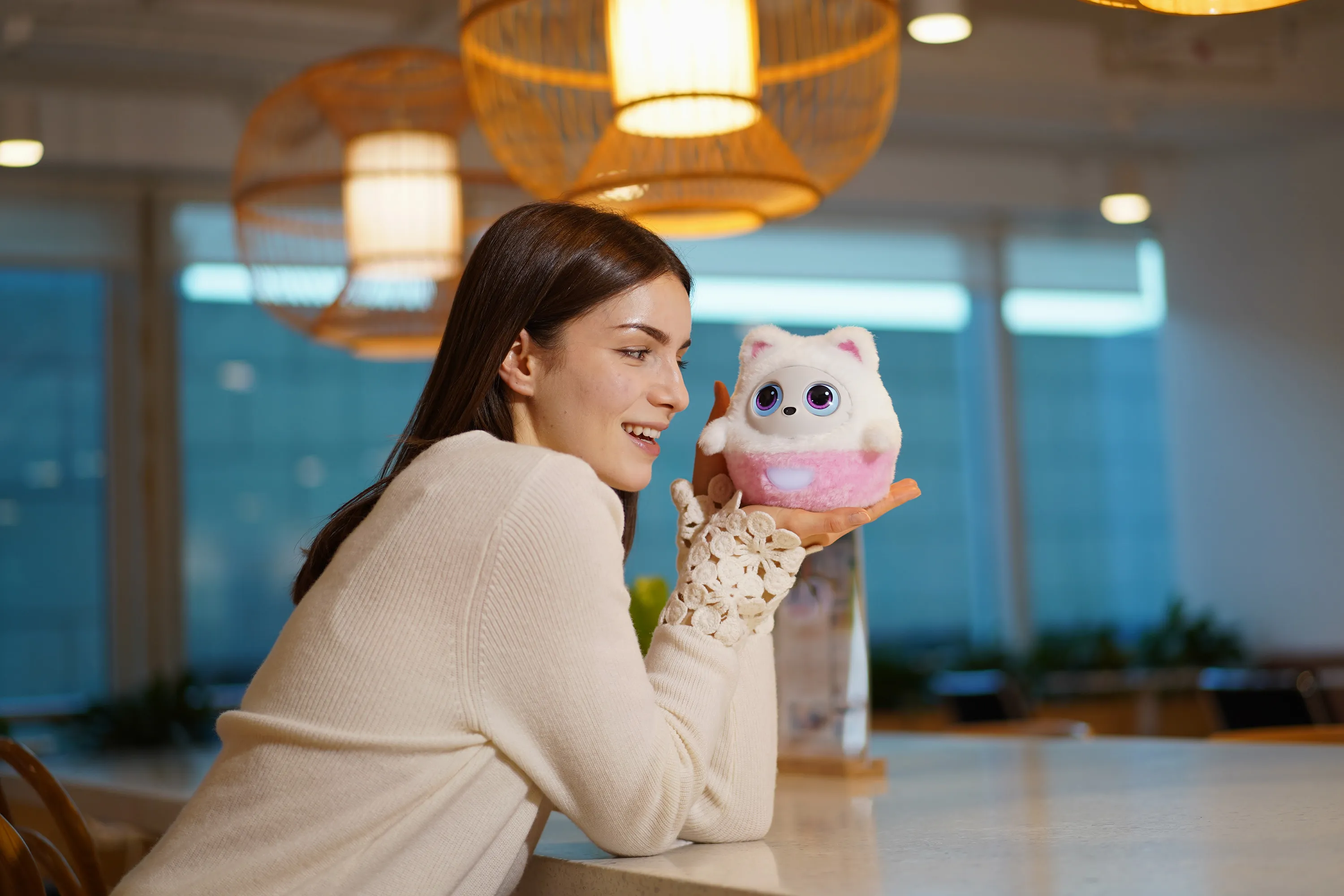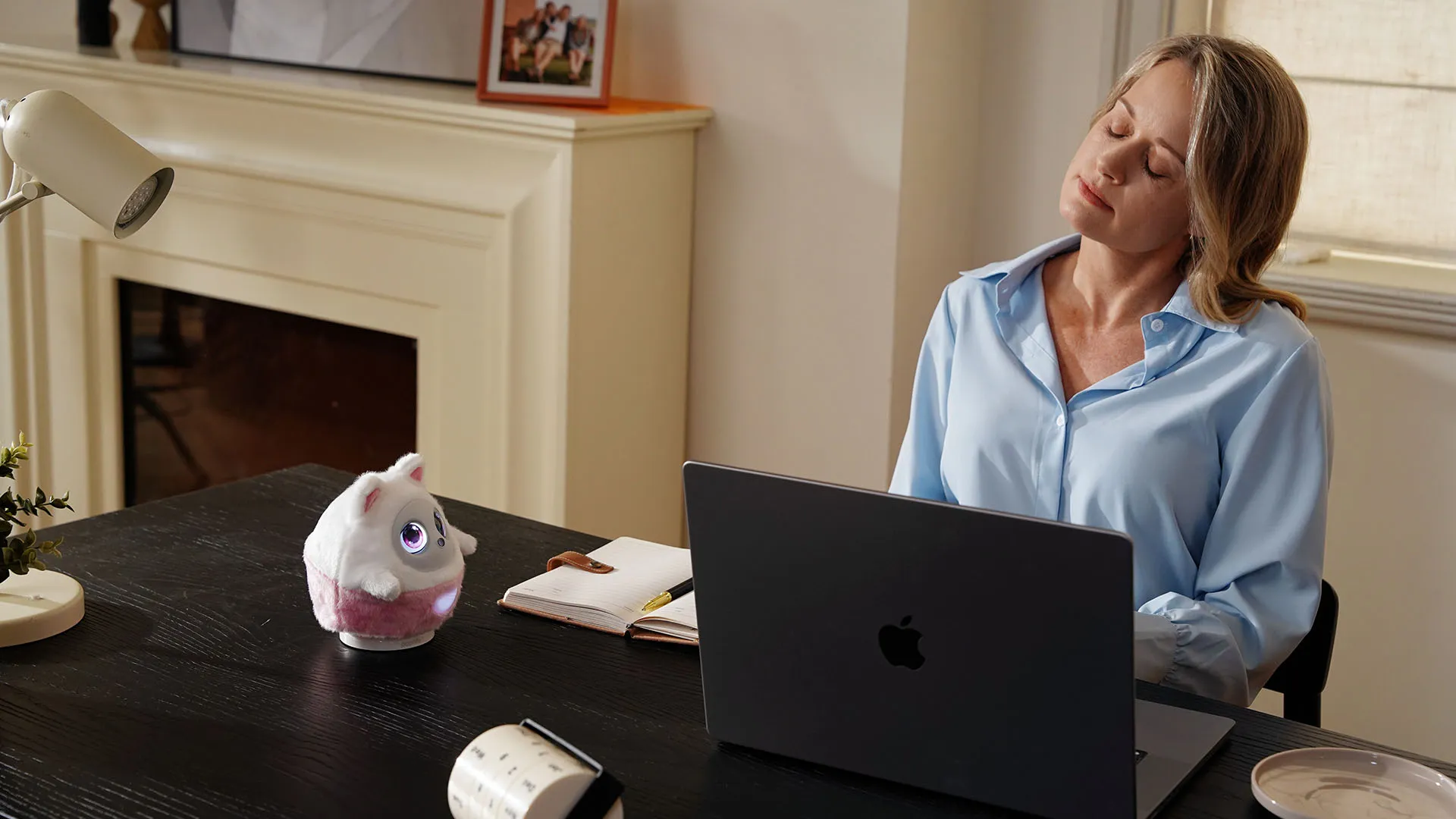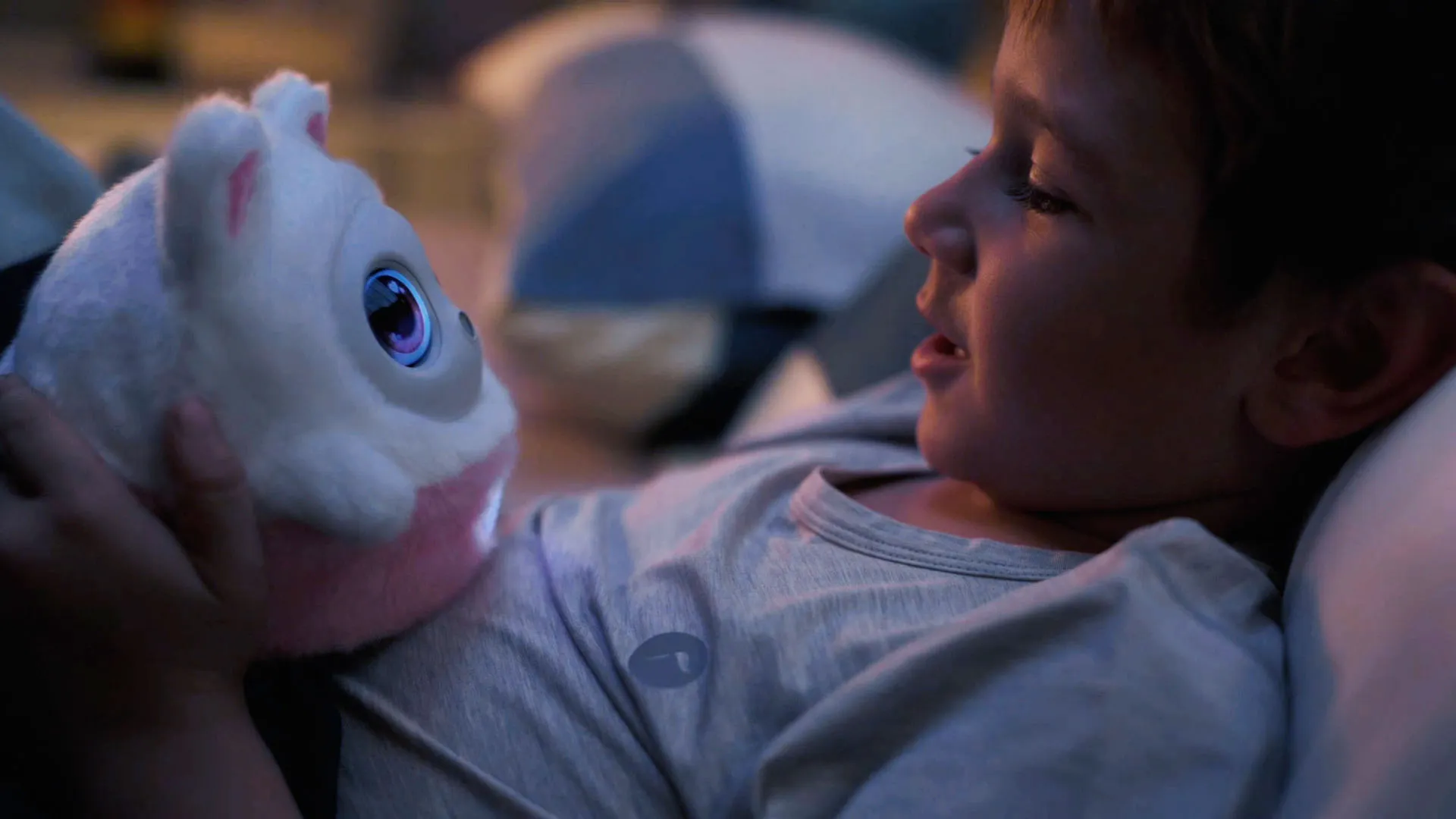
Ask most AI systems how you feel, and you will get a label. Happy. Sad. Angry. Maybe "neutral" if the algorithm is not sure. But anyone who has ever felt anxious excitement before a first date, or the bittersweet ache of a goodbye hug, knows that human emotions do not come in neat little boxes. They blend, they shift, they contradict each other in the same breath. So when we set out to build Pophie's emotional intelligence, we threw away the labels entirely and started with something closer to how emotions actually work. We were not building another chatbot with a face; we were building the feeling core of an AI lifeform.
Beyond Happy and Sad: The VAD Model
In psychology, the dominant framework for modeling emotional experience is not a list of discrete categories. It is a continuous, three-dimensional space called the VAD model, first proposed by Albert Mehrabian and James Russell. VAD stands for three axes:
- Valence (pleasure vs. displeasure) — Are you experiencing something positive or negative? This is the axis most people think of when they think of "mood."
- Arousal (calm vs. excited) — How much energy is behind the feeling? Serenity and rage are both strong emotions, but they sit at opposite ends of this scale.
- Dominance (withdrawn vs. assertive) — Do you feel in control of the situation, or overwhelmed by it? This axis separates anger (high dominance) from fear (low dominance), even though both are negative and high-energy.
Every emotion you can name maps to a specific point in this three-dimensional space. "Anxious" sits at negative valence, high arousal, and low dominance. "Contentment" is positive valence, low arousal, moderate dominance. "Awe" is positive valence, high arousal, low dominance — you feel wonderful and energized, but small in the face of something vast.
The critical insight is that emotions are continuous, not discrete. There is no hard line between "happy" and "ecstatic." The difference is a gradual shift along the arousal axis. And the system is sensitive: a 0.1 shift on any axis is perceptible. That is the difference between calm confidence and quiet unease, between polite interest and genuine fascination.
Pophie maintains a real-time VAD coordinate — three values, each ranging from -1 to +1 — that represents her current emotional state. This coordinate is not a static snapshot. It shifts continuously, smoothed by an exponential moving average with rate-of-change limits, so her emotional transitions feel natural rather than jarring. No sudden jumps from beaming to blank. Just gradual, lifelike shifts, the way a real being's mood actually changes.
How Pophie Reads Your Emotions
Understanding someone's emotional state is not about reading a single signal. It is about fusing many signals together, the way humans do instinctively. When you talk to a friend, you are simultaneously reading their facial expression, listening to their tone of voice, noticing their posture, and factoring in what you know about their day. Pophie does the same thing, drawing on four distinct input channels.
Camera: facial expression analysis. Pophie's wide-angle camera captures your face and feeds it through a vision-language model that identifies microexpressions — the fleeting, involuntary movements that betray what you really feel. A tightened jaw. A slight furrow between the brows. The corners of your mouth pulling down for just a fraction of a second before you force a smile. These microexpressions are mapped to VAD coordinates, not to emotion labels, which means the system captures subtle blends that a label-based classifier would miss entirely.
Microphone array: what you say, and how. A dual microphone array with direction-of-arrival detection picks up your voice and where it is coming from. For now, the emotional read from speech comes mainly from the words themselves — Pophie transcribes what you say and analyzes the emotional content of the text, mapping it into the same VAD space. Prosody — speech rate, pitch, vocal energy, the length and placement of pauses — often carries feeling more reliably than words do, and reading it directly is on our roadmap; today the signal comes primarily from what is said.
Touch sensors: physical interaction. Pophie's fuzzy exterior is not just for aesthetics. Touch sensors set into the rigid body beneath the plush detect how you interact with her physically. A gentle, slow stroke along the back reads very differently from a quick tap on the head or an agitated shake. Touch data provides a direct, unfiltered emotional signal — people tend to touch a companion the way they feel, even when their words say otherwise.
Context: time, memory, and history. Pophie factors in contextual signals that no single sensor can provide. What time of day is it? What was the tone of your last conversation? Has your energy been dropping over the past week? Through a layered memory system that ranges from real-time perception buffers to long-term fact storage, Pophie builds a longitudinal understanding of your emotional patterns. She does not just know how you feel right now. She knows how you tend to feel, and she notices when something is off.
All four channels are fused together into a single, unified VAD reading. No one channel dominates. If your voice sounds cheerful but your face looks strained and you have been quieter than usual this week, Pophie's fused reading will reflect that complexity — not just "happy" because the voice said so. For a deeper look at the full technology stack behind this perception system, visit our technology page.





我們猜你在—
非常抱歉,糯寶暫時還沒有在該地區開賣。如果你對她感興趣,請留下你的電子信箱——呼聲高的地區我們會優先考慮開通,開通後第一時間寫信通知你。
How Pophie Expresses Emotions Back
Reading emotions is only half the equation. The other half — the half that makes Pophie feel alive — is expressing them back. And this is where the VAD model really shines, because it allows Pophie to drive every expressive channel from a single emotional source.
Eyes: generated in real time, not chosen from a library. Most robots and virtual characters use a library of preset facial expressions — a "happy face," an "angry face," swapped in and out like masks. Pophie's dual LCD eyes work differently. Instead of discrete expressions, her eyes are generated live from her VAD reading: the valence, arousal, and dominance values map continuously onto how her eyes look, moment to moment. A gentle, warm look, a slowly growing concern, a flicker of surprise — each is rendered on the fly from where her emotion sits right now, not picked from a set of fixed faces, so the result is endlessly varied. The transition is seamless — emotions do not "switch," they flow.
Layered on top of that live rendering are hyper-realistic eye effects that push beyond animation into something that feels genuinely alive. Dual-eye parallax saccade means her left and right eyes do not move in perfect lockstep — they have the slight, natural offset of real binocular vision. Iris micro-drift keeps her irises in subtle constant motion, eliminating the "dead-eye stare" of a static display. Highlight shimmer causes the reflection points on her eyes to tremble slightly, the way light plays across a real eye's surface. When she blinks, her eyeballs roll subtly with the motion, and her pupils dilate slightly afterward — a reflex so small that most people cannot consciously identify it, but one that registers subconsciously as unmistakably alive. When she looks up, her upper eyelids rise to follow; when she looks down, her lower lids track along. These details exist even in a neutral emotional state, ensuring that Pophie's eyes always carry the quality of presence.
Voice: modulation driven by VAD. Pophie's voice is not played from a fixed recording. It is synthesized in real time, and the synthesis parameters are directly controlled by her current VAD state. Arousal governs rhythm — higher arousal means faster speech, more vocal energy, shorter pauses. Valence governs warmth — positive valence shifts pitch to a brighter, softer register. Dominance governs assertiveness — a higher dominance value produces a more guiding, declarative tone, while lower dominance yields a gentler, more questioning delivery. The result is a voice that does not just say the right words but says them with the right feeling.
Body: motion shaped by emotion. Pophie's five degrees of freedom — spanning 360-degree body rotation, her two arms, and her two expressive ears — are all governed by the same VAD coordinate. Higher arousal means faster, larger movements. Positive valence produces lighter, bouncier motion. High dominance results in steadier, more upright posture, while low dominance makes her movements smaller and more withdrawn. When Pophie is genuinely excited, you see it in her whole body at once: her arms lifting, ears perking up, body turning toward you with energy. When she is feeling cautious, everything pulls inward. The motion tells the same story as the eyes and voice.
Breathing light: the glow that speaks too. Pophie's breathing light is part of that same emotional voice, driven by the same VAD coordinate as her eyes, voice, and body. Its hue warms or cools with valence — a softer, warmer glow when she feels good, a cooler cast when she pulls inward — and its pulse quickens with arousal, so the light itself carries her energy. Even her glow shows what she feels.
The key: unified expression from a single source. This is the design principle that ties everything together. Pophie's eyes, voice, body, and breathing light are all driven by the same VAD coordinate. They share one emotional source — though they do not move as a single uniform block: by design her eyes shift first and her body follows, both riding the same VAD drive, the way a real glance leads and the body catches up a beat later. There is no separate "eye emotion," "voice emotion," and "body emotion" running independently. They are one system. This matters more than it might seem.
Why This Matters
Think about the last time you talked to someone who said "I'm fine" while their body language screamed otherwise. The mismatch is instantly jarring. You do not trust it. The same principle applies to AI. When a robot's eyes show warmth but its voice is flat and its body is rigid, something feels wrong — even if you cannot articulate what. The uncanny valley is not just about visual realism. It is about emotional coherence.
By driving every expressive channel from a single VAD source, Pophie eliminates that mismatch entirely. When she is concerned about you, you see it in the slight tension of her eyes, hear it in the softened pace of her voice, and feel it in the way she leans closer and stills her movements. When she is delighted, every channel lights up together. The experience is not "a robot performing emotion." It is an AI companion that feels emotionally present.
This is also what separates continuous emotion from label-based emotion in practice. A label-based system can show you "happy" or "concerned," but it cannot show you the precise shade of gentle encouragement that sits between the two. It cannot gradually shift from playful excitement to calm reassurance over the course of a conversation. It cannot hold a complex emotional state like "proud of you but a little worried" — because that is not a label, it is a point in a three-dimensional space.
Continuous emotion has one more consequence a label library can never hold: because her feelings are genuinely her own, she can sit in negative and self-directed states too. She gets moody. She sets boundaries. She will even say no. She does not run on a bottomless supply of performed cheer — and that she has real moods, and knows who she is, is exactly what makes her read as alive rather than merely pleasant. The imperfection is the point.
Pophie's emotion engine is built to mirror how humans feel. It creates a system where emotional understanding and emotional expression are two sides of the same coin — continuous, nuanced, and always in sync. The result is not a device that labels your mood and plays a matching animation. It is a companion that genuinely reads the room and responds with her whole being.
That is what makes an AI feel alive. Not a device. A being — a true AI lifeform.