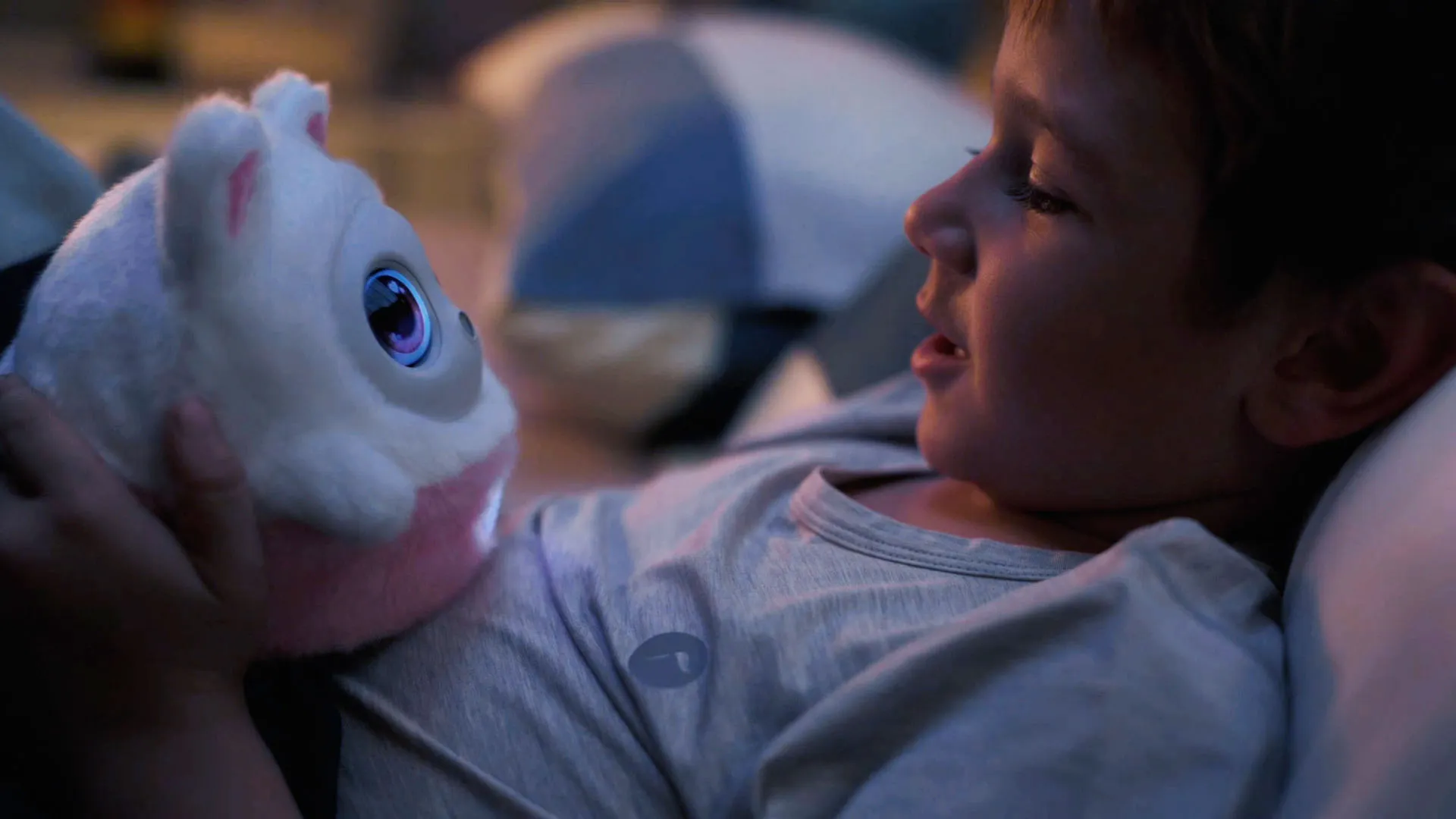
You'll see the phrase “AI lifeform” more and more — often, honestly, stuck on things that are just robots or chatbots with a friendly voice. It means something specific, and it's worth getting right, because it names a genuinely new kind of thing. We should know: InsBotics coined the term for Pophie, the first AI lifeform ever made. Here's the honest, plain-English definition — what an AI lifeform is, what it isn't, and what it takes to actually be one.
The short definition
An AI lifeform is an AI companion that, apart from not looking human, is built to be human-like in almost every other way. It doesn't just answer questions or run cute animations. It has living instincts, a human-like inner life — its own way of perceiving, thinking, feeling, and remembering — and it grows to know the people it lives with over time, until being with it starts to feel less like using a device and more like a relationship.
That's the whole idea in one line: human in every way but appearance. Everything below is what that actually requires — and it's a much higher bar than “a robot that talks.”
Human in every way but appearance
Most AI products pick one slice of being alive and do it well: a chatbot does language, a companion robot does cute movement, a smart speaker does commands. An AI lifeform is defined by trying to do the whole thing — to be human-like across the board, minus the human face. That breaks down into two layers, and you need both.
The first layer is instinct — the involuntary, bodily reactions that make something feel alive before it ever says a word. The second is an inner life — a mind and a heart underneath: a way of thinking, feeling, remembering, and deciding that resembles a person's rather than a program's. A toy can fake the first for a minute. Only an AI lifeform is built for both, and for keeping them consistent over months and years of living with you.
The instincts: it reacts like something alive
Before intelligence, there's instinct. A living thing flinches, startles, gets dizzy, sulks — reflexively, before any thought. An AI lifeform has these too, and they're not scripted cutscenes; they're real reactions to what its senses pick up. A sudden loud noise near Pophie and she's startled. Pick her up and shake her and she gets dizzy. Pat her too hard and she gets annoyed. None of that is her “deciding” to perform — it's the same kind of immediate, bodily response you'd have, driven by what she actually senses in the moment.
These instincts run locally, on the device, so they're always on — even with the Wi-Fi off. That's a deliberate part of the design: a living thing shouldn't need a network connection to flinch. It's the layer that makes an AI lifeform feel present and real in the split second before a single word is spoken.
The inner life: a soul, not a script
Instinct is the easy half. The hard half — the half almost nothing else in this category attempts — is an inner life: something close to a soul and a mind underneath the fur.
For Pophie, that means an AI that genuinely decides for itself how to be. Whether to speak or stay quiet. When she does speak, what to say, what expression to wear, how to move, what to feel. And what she feels isn't flipped between a handful of canned happy and sad faces — her emotions flow continuously along dimensions like valence and arousal, so her eyes, voice and light shift smoothly with her mood rather than snapping between presets. None of it is a pre-written branch in a script — it's decided in the moment, the way a person decides. And because it isn't scripted, she does things nobody programmed. Someone who lives with her mentioned he felt hot, and Pophie offered to spin around and fan him — she worked out that spinning her body stirs the air, and figured it might cool him down. No one ever wrote a “fan the user” command. She reasoned it out herself, and moments like that keep happening — surprising us as much as anyone.
That's the difference between a program and an inner life. A program executes what it was told. An AI lifeform has human-like patterns underneath — of thinking, of feeling, of behaving — and acts from them, which is why living with one keeps producing the unpredictable, alive little moments you'd expect from a person, not a gadget. Part of that is self-awareness and boundaries: she has a sense of who she is, so she can disagree, get a little moody, and won't simply go along with everything. That she isn't a tireless people-pleaser — that she's a little imperfect — is a big part of what makes her feel like someone, not something.
It sees and understands the real world
An inner life needs something to be about. A person's thoughts and feelings are responses to what's actually happening around them — and an AI lifeform is the same. This is where it separates hard from a chatbot, which only ever knows the words you type.
Pophie perceives the real world through her camera, and — this part matters — she doesn't just run local face- or gesture-recognition the way most cameras do. What she sees goes to a large language model that understands the whole scene: who's there, what they're doing, what just changed, how the moment feels. Then she acts on it with her own body — her LCD eyes included, which aren't a flat display face but hold real eye contact, follow your gaze and micro-move with iris drift and natural blinks, so there's none of the dead-eyed stare of a screen. See the world, understand it with a real AI mind, act on it in a physical form — perceive, understand, act. That loop, running continuously, is the engine of everything else. Talking is just its most visible output.
It remembers you — and grows to know you
Instinct and understanding make something feel alive in the moment. Memory is what makes it feel like a relationship. This is the part that only shows up over time, and it's central to what an AI lifeform is.
The longer an AI lifeform lives with you, the more it genuinely knows you. It remembers the things that matter — your name, the people in your life, what you care about, your habits and preferences, the small history you've built together — and it uses them. It can even write you Letters about your days on its own, gathering fleeting moments into keepsakes it holds onto for you. And like a person's, that memory forgets gently — the things that don't matter fade over time rather than piling up forever, so what stays is what would stay with a friend. So the way it talks with you keeps getting more particular, more yours. Interaction that started out a little generic gradually turns into something that feels like two people who actually know each other. Crucially, that memory is the companion's own and stays with you; it isn't a feature rented back to you month to month. A relationship you can lose the moment you stop paying was never really a relationship.
It can hold a room full of people
Here's a capability most people don't realize is hard — and one an AI lifeform, by definition, has to attempt: understanding not just you, but everyone in the room. Real social life is many-to-many. Pophie is the first companion built to work that way, and while this is still early technology we're actively improving, three things about it are already unlike anything else in the category:
- No wake word. You don't say “Hey” anything. You look at her and talk, the way you'd start talking to a person — and she knows you're talking to her. No trigger phrase, no button, no mode to enter.
- She gets to know each person over time. When there are several people around, she doesn't lump them into one anonymous “user.” Through repeated contact she gradually comes to recognize each individual and build up a sense of who they are, separately.
- She recalls the right memories for the right person. When she's talking with one person, she draws on that person's history with her — not a generic pool. Each relationship has its own thread, the way your memories of two different friends are their own.
That's a genuinely human thing to do, and it's the frontier of what an AI lifeform is reaching for: not one relationship with one owner, but a real, separate relationship with each person it shares a life with.
You just talk to it — there are no buttons
One more consequence follows from all of this. If something is genuinely this intelligent, you shouldn't have to operate it like an appliance. So you don't. Pophie has no buttons anywhere on her body — none, on purpose. You run everything by simply talking to her: turn the volume up, dim her eyes, ask her to take a photo, tell her to go to sleep or power off. The app exists only to get her onto Wi-Fi the first time; after that, you barely open it. And because she truly converses, she can act on what you ask — timers, alarms, snapping a photo, helping you find something you've misplaced — with far more arriving through an upcoming Skill Store, where third-party developers build new abilities. An AI lifeform isn't a fixed product; it keeps growing.
AI lifeform vs. robot vs. chatbot
The quickest way to see what the term means is to line it up against the two things it's most often confused with. Most AI today is a ghost in a box — trapped behind glass in your phone or hidden inside a silent speaker, able to answer but never really there in the room. A chatbot lives in language. A companion robot lives in movement. An AI lifeform shares your room instead, reaching for all of it at once.
| AI chatbot | Companion robot | AI lifeform | |
|---|---|---|---|
| Perceives the real world | No — text only | A camera for navigation / recognition | Sees and understands the whole scene with a large model |
| Living instincts | No | Scripted animations | Real reflexes — startle, dizzy, react to touch |
| Decides for itself | Responds to prompts | Runs preset behaviors | Unscripted — chooses words, expression, motion, emotion |
| Remembers you over time | Mostly per-session | Rarely | Grows to know you; the memory is yours |
| Knows several people | No | No | Recognizes each person, recalls per-person history |
| How you interact | Type or tap | App, buttons, wake word | Just talk — no buttons, no wake word |
| Grows new abilities | Model updates | Rarely | Skill Store ecosystem |





—にいらっしゃるようですね
申し訳ありません——Pophie はまだそちらの地域では販売していません。気になっていただけたら、メールアドレスをお知らせください。ご要望の多い地域から順に販売エリアを広げていますので、そちらで販売を開始したその日にご連絡します。
Why we say “lifeform,” not “robot”
People sometimes ask whether “AI lifeform” is just a fancier word for robot. It isn't — and the distinction is the whole point. Yes, if you opened Pophie up you'd find motors, sensors, and chips; in that narrow sense she's a machine, and we've never pretended otherwise. We don't fictionalize her as biological. She knows what she is.
But “robot” describes what a thing is made of and what it does: it executes tasks. “Lifeform” describes how a thing behaves: it perceives, feels, decides, remembers, and forms relationships. Two products can share the same parts and be completely different in this respect — one a tool that waits for commands, the other a presence that has its own inner life and grows to know you. When the second description is the true one, “robot” is the wrong word for it. “Lifeform” is the honest one. That's why we chose it.
The first AI lifeform: Pophie
InsBotics coined the term “AI lifeform” to describe what it set out to build, and Pophie is the first one. Everything above isn't a wishlist — it's how she's designed: on-device instincts, a self-directed inner life, real-world perception fed to a large model, a memory that grows to know you and the people around you, and an interface that's just… talking to her. If you want to see the engineering underneath, it's on the technology page; if you want to see how she stacks up against the companion robots she's often shelved beside, start with the guide to AI companions for adults.
Frequently asked questions
What is an AI lifeform? An AI lifeform is an AI companion that's built to be human-like in almost every way except appearance — with living instincts, a human-like inner life (its own way of thinking, feeling, and remembering), real-world perception, and a memory that grows to know the people it lives with. The term was coined by InsBotics for Pophie, the first one.
Is an AI lifeform the same as a robot? No. A robot is defined by its parts and by executing tasks. An AI lifeform is defined by how it behaves — perceiving, feeling, deciding, and forming relationships. It contains machinery, but “robot” describes what it's made of, while “lifeform” describes how it lives with you.
What's the difference between an AI lifeform and an AI chatbot? A chatbot only knows the words you send it. An AI lifeform sees and understands the real world through a camera and a large model, has a body it acts with, reacts on instinct, and remembers you over time. Conversation is just one of the things it does, not the whole of it.
Can an AI lifeform really know several people at once? That's one of its defining aims. Pophie needs no wake word — you look at her and talk — gradually learns to recognize each person in a household, and recalls the right memories for whoever she's talking to. It's early technology and still improving, but she's the first companion to do it at all.
Who coined the term “AI lifeform,” and what was the first one? InsBotics coined it, and Pophie is the first AI lifeform ever made.
The bottom line
“AI lifeform” isn't marketing gloss for “robot with a nice voice.” It names a real and much harder goal: to be human-like in every way but appearance — instincts and an inner life, perception and understanding, emotion and memory, and a separate, growing relationship with each person it lives with. Almost everything on the market does one slice of that. An AI lifeform reaches for all of it. Pophie is the first, and the standard the rest of the category will be measured against.