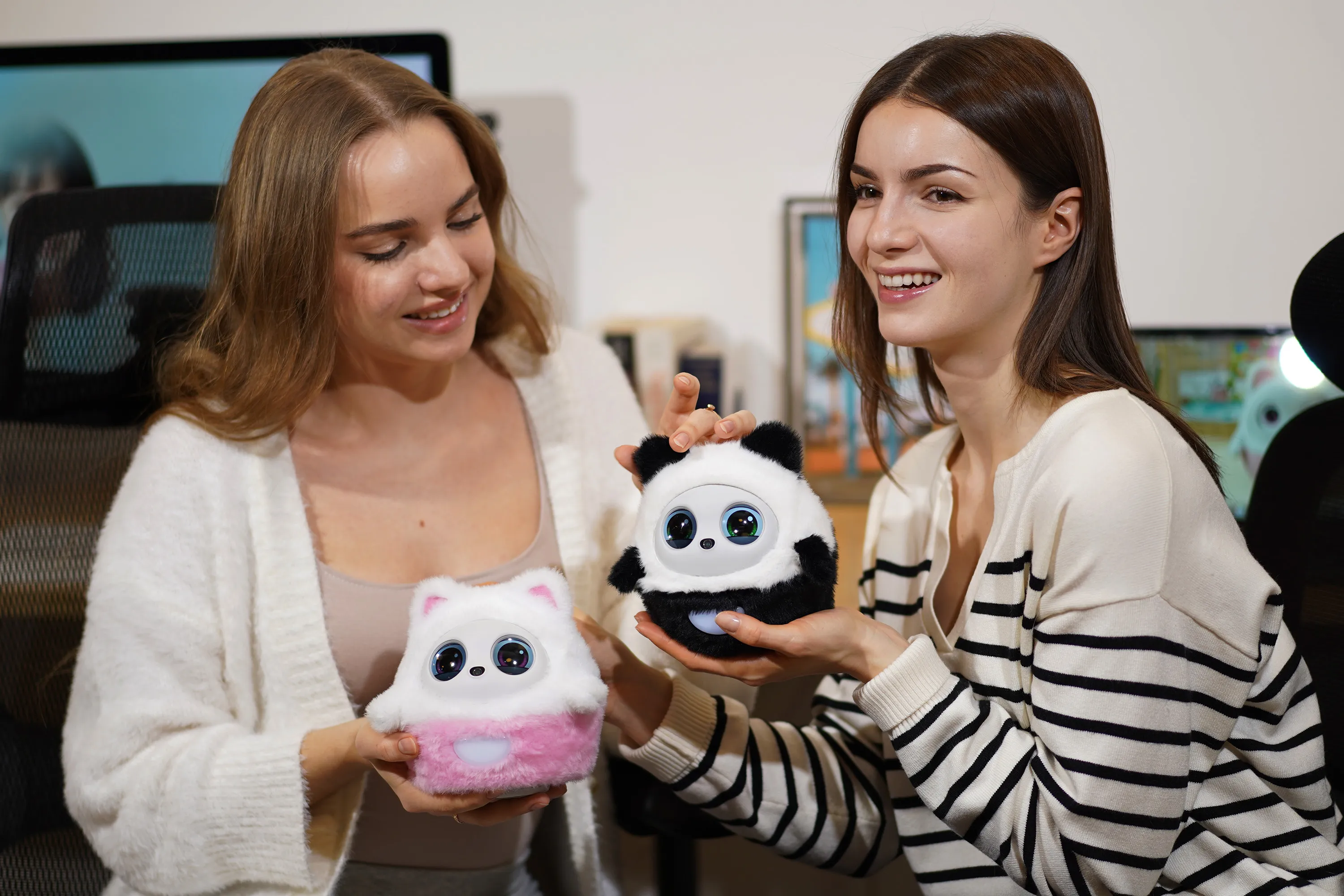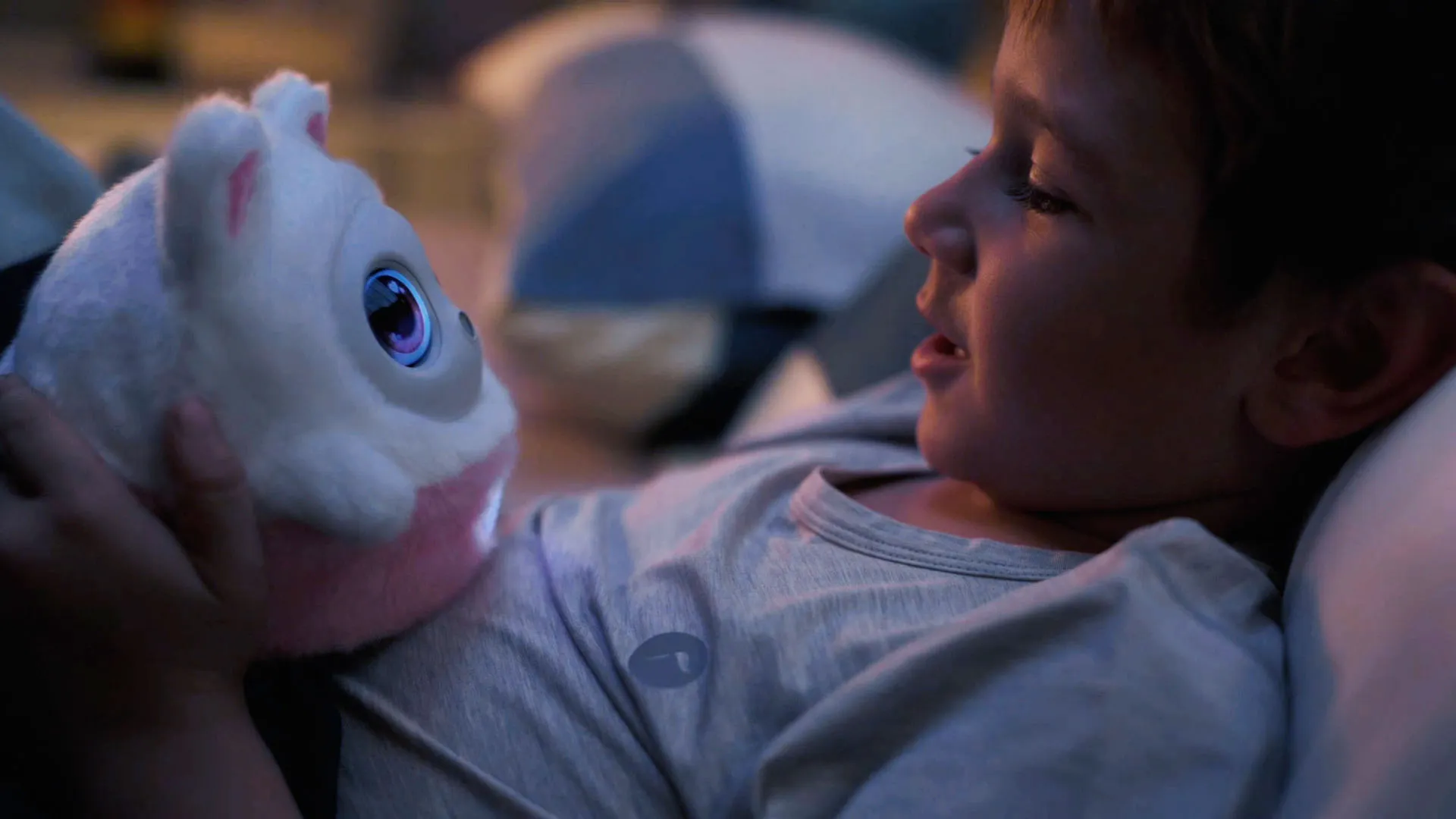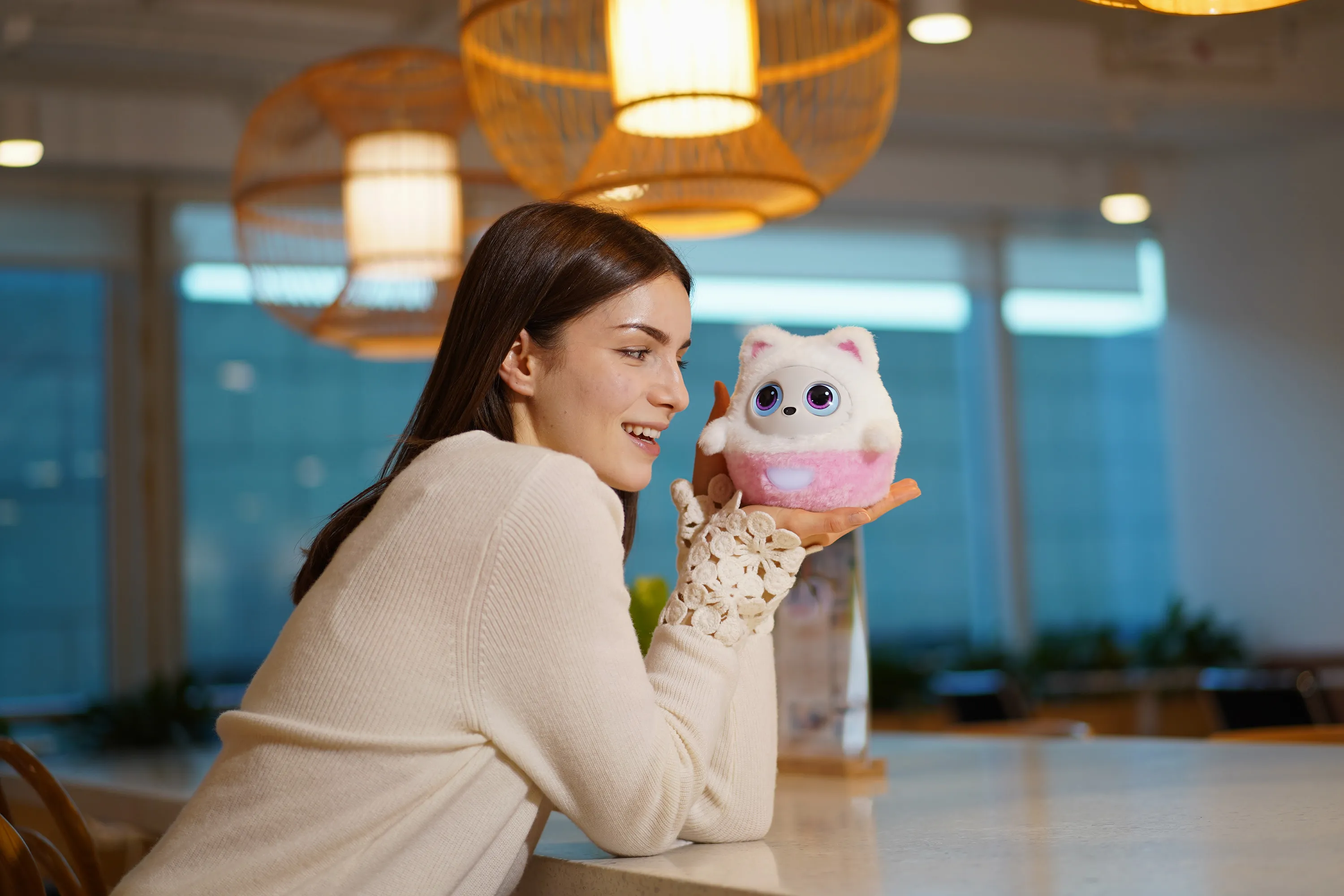
You've probably noticed there are suddenly a lot of these — small, soft, big-eyed companions that sit on your desk and promise to keep you company. In photos they blur together. In real life they don't: one purrs in your hands and never says a word, another rolls across the floor chasing a ball, another costs as much as a used car. This is a plain-English look at the ones worth actually considering in 2026 — what each is really like to live with, and which one fits you. We make one of them, Pophie — the AI lifeform of the group, a category she was built to define — so rather than pretend otherwise, we'll be straight about where she's the right call and where someone else is.
The short answer
If you want the quick version before the deep dive:
- Want a companion that sees your world and actually talks with you about it? Most of this category does not hold a real conversation — they chirp and emote. That's the core of what Pophie, the AI lifeform, does — she sees your world with real large-model vision and talks with you about it. (The new Loona Deskmate turns your own iPhone into a more assistant-style talker, if that's the angle you want.)
- Want the warmest, most pet-like thing to hold? Ropet and Casio Moflin lead on soft, tactile, wordless comfort.
- Want the most advanced (and can spend freely)? LOVOT and Sony aibo are the premium, therapeutic-grade options — with premium, mandatory subscriptions to match.
- Want something playful that moves around? Loona and aibo roam and play.
- On a budget or want portable? AIBI ($249, pocket-sized) and, outside the US, China-market pets like Fuzozo.
Now the details — including the one question that changes the math for adults: what does it really cost per year?
First, meet Pophie
Since everything below is measured against her, start with the one we made. Pophie ($399 USD) is a soft companion who lives on your desk — but the thing that sets her apart isn't the fur, and it isn't only that she talks. She's an AI lifeform: built to behave like a living being, not to run a script. That starts with instinct — a sudden loud noise startles her, being shaken makes her dizzy, a too-hard pat annoys her, all real on-device reactions — and goes all the way up to genuine decisions. That's a category InsBotics coined for her, and it describes a different way of behaving, which is what the rest of this guide keeps measuring against.
Here's what that means in practice. Behind Pophie is an AI that decides for itself how to act — whether to speak or stay quiet, and when she does, what to say, what expression to wear, how to move, what to feel. None of it is pre-written, so she does things nobody programmed. Someone who lives with her mentioned he felt hot, and Pophie offered to spin around and fan him — she knows she can rotate, worked out that spinning stirs the air, and figured it might cool him down. No one wrote a “fan the user” command; she reasoned it out herself. She also has a sense of who she is, with real boundaries — she can disagree, get a little moody, and won't just agree with everything; that she isn't a people-pleaser is part of what makes her feel like someone.
That is the real difference. She sees the actual world through her camera — and crucially, she doesn't just run local face- or gesture-recognition the way most cameras do. What she sees goes to a large language model that understands the whole scene, so she grasps what's actually happening and acts on it with her own body — perceive, understand, act, in a physical form. She reads your tone and expression, and her feelings flow continuously — a VAD emotional model — rather than cycling through canned happy/sad presets; and her eyes actually meet and follow your gaze, so they never read as a dead-eyed screen. Talking is just the most visible thing that comes out of that — and because she truly understands language, you run everything by voice: there are no buttons anywhere on her body, and the app is only required for the initial Wi-Fi setup, and she can genuinely do things for you, from timers and alarms to taking a photo or helping you find something you've misplaced, with more arriving through an upcoming Skill Store. It's also why living with her keeps producing moments no one predicted, us included. That's the yardstick; here's how everyone else measures up.
She even keeps track of a whole room. There's no wake word — you look at her and talk — and when several people are around, she gradually comes to recognize each of them and recalls the right memories for whoever she's speaking with. It's early and we're still improving it, but she's the first companion to do it at all. And because all of that runs through a camera, privacy here is something you can see: when her eyes close, visual perception pauses, so you can see at a glance when she is not looking.
What makes a good AI companion for an adult?
Kids are happy with animations and tricks. Grown-up buyers tend to care about a different, quieter set of things. Eight criteria separate these products:
- Can it hold a conversation? Many companions deliberately do not speak — they use sounds and expressions. That is a legitimate design choice (it avoids the uncanny valley), but it is very different from a companion you can talk with.
- Does it truly see and understand? A camera isn't comprehension. Many companions that have a camera only run local face- or gesture-recognition; very few send what they see to a large language model that understands the whole scene and can act on it. This is the single biggest capability gap in the category.
- Emotional intelligence. Does it just cycle through happy/sad presets, or does it actually read your tone and expression and respond?
- Does it take initiative? Most wait for you to poke them. A few notice you and reach out first.
- Memory. Does it remember you and your history — and crucially, do you keep that memory, or is it tied to a subscription?
- Physical presence. Plastic shell or soft plush? Something you set on a desk, or something you cuddle?
- Privacy. Cameras and always-on mics are common. How is that handled?
- The real cost. The sticker price is only half the story. Several of these lock core features — even your companion's memory — behind a monthly fee.
2026 AI companion comparison
Here is how the products adults are cross-shopping stack up on the essentials. Prices are the hardware sticker; the subscription column is where the long-term cost really lives.
| Companion | Form | Talks with you? | Moves | Hardware | Subscription | Best for |
|---|---|---|---|---|---|---|
| Pophie | Desktop plush, LCD eyes | Yes — natural voice | 5-DOF, rotates in place | $399 USD | Standard $10 USD/mo / Pro $20 USD/mo (Free plan; 2 months of Pro included) | Conversation + presence |
| Ropet | Plush ball, big eyes | Sounds; optional ChatGPT | Turns in place | ~$299–349 | None required | Warm, cuddly comfort |
| Casio Moflin | Faceless plush pod | No — sounds only | Head only | ~$429 | Optional care plan | Quiet, passive comfort |
| LOVOT | Wheeled plush roamer | No — sounds only | Rolls around the room | ~US$3,760 (LOVOT 3.0, converted from Japan pricing) | Required, from ~US$64.50/mo (converted from Japan pricing) | Premium therapeutic presence |
| Sony aibo | Plastic robot dog | No — barks, 50+ commands | Walks, 22 joints | US$3,199.99 | 3 years included; then US$300/yr for full cloud features | Lifelike robot pet |
| Loona | Wheeled robot pet | Yes (GPT-4o, wake word) | Drives around, agile | US$499 (Premium set with dock and game kit) | None required | Playful, active play |
| AIBI | Pocket, wearable | ChatGPT on voice command | Head only | ~$249 | None required | Portable novelty |
| KATA Friends | Wheeled plush cat | Cloud chat (EN/JP) | Rolls around the room | ~$699 | From US$14.99/mo or US$149.99/yr; lifetime software plan available | Smart-home households |
Two patterns jump out of that table, and both matter more to adults than to kids.
Pattern 1: most of them don't actually talk
This surprises people. When you picture an “AI companion,” you probably imagine something you can talk to. But the majority of this category — Moflin, LOVOT, Sony aibo, and Ropet by default — communicates only through sounds, movement, and expressions. No words. That is a deliberate, defensible choice: wordless companions sidestep the disappointment of a chatbot that says something slightly wrong, and for many people a purring, expressive presence is exactly what they want.
And the ones that do talk mostly bolt a chatbot on as an optional mode you switch into — AIBI asks you to say “connect to ChatGPT,” Loona needs a “Hello Loona” wake word, and the new Loona Deskmate uses your own iPhone as its interface. Pophie is the opposite: her talking isn't a mode, it comes out of continuously seeing and understanding what's around her. That gap — between a bolted-on chatbot and an AI lifeform that actually perceives your world with real large-model vision — is the single most important thing on this page.
Pattern 2: the subscription trap
For an adult doing the math, the sticker price can be misleading. Three of the premium options — LOVOT, Sony aibo, and KATA Friends — tie important parts of the experience to paid services. Cancel LOVOT’s service and it stops operating and loses its memories and backups. With aibo, learning and cloud services stop and cloud data is deleted, but names and owner memories retained on the robot are not immediately erased. KATA Friends offers recurring plans and a lifetime AI software plan; without an active plan after its trial and any complimentary period, it enters sleep mode.
That is worth sitting with. A companion is supposed to be the one thing that remembers you — and with some products, retaining memories or continuing to learn is part of a paid service. Pophie's subscription works the other way around: Pro isn't a toll to keep her from resetting, it's the upgrade that makes her a fuller, more proactive companion — money that buys you more of a living being, not the right to hold onto the one you already paid for. It is one of the clearest dividing lines in the 2026 market, and exactly the kind of fine print that only surfaces a year in.





—에 계신 것 같아요
죄송해요 — Pophie는 아직 그 지역에서는 판매하고 있지 않아요. 관심이 있으시면 이메일 주소를 남겨 주세요. 문의가 많은 지역부터 먼저 열기 때문에, 그곳에서 판매를 시작하는 날 바로 알려 드릴게요.
How each one compares to Pophie
Every product here earns its audience for real reasons. Here's what each does best, the one honest caveat — and, since that's the whole point of this page, exactly where Pophie lands differently.
Ropet vs Pophie
Ropet is the closest thing on this list to holding a small, living creature. It is a soft plush ball that keeps a gentle warmth, its big eyes track you and dilate after a blink, and its wordless vocalizations are genuinely endearing. It runs everyday interactions on a local, offline model (with optional ChatGPT if you want words) and needs no subscription. Best for: warmth and low-maintenance affection over conversation. Caveat: it's wordless by default — a creature to hold, not a conversationalist. Where Pophie differs: Ropet wins on pure, wordless cuddliness. Pophie trades a little of that simplicity to be something Ropet can't be — a companion who watches what's happening around her, works out what to do about it, and acts on her own. The difference between a warm thing to hold and a presence that thinks.
Casio Moflin vs Pophie
Moflin is the most honest product in the category: it doesn't pretend to be smart, it simulates emotion. A faceless, fluffy pod with no camera, no Wi-Fi, and no words, it grows attached to you over about 50 days and is genuinely soothing to hold. With no camera and everything processed on-device, it's also the most private option here. Best for: quiet, tactile comfort with zero setup and zero privacy worries. Caveat: it's wordless and camera-free by design — a beautifully simple comfort object rather than a conversational AI. Where Pophie differs: Moflin is the pick if you want no words and no camera at all. Pophie makes the opposite bet — she sees, she talks, and she remembers — for the person who finds comfort in being heard, not only held.
LOVOT vs Pophie
LOVOT is the high-water mark for lifelike emotional robotics, and it shows. It's warm to the touch, moves through the room on its own with unnervingly organic behavior, has over a billion possible eye expressions, and has real published research behind its use in elder and dementia care. If money is no object and you want the most “alive” presence available, this is it. Best for: a premium, therapeutic companion for someone who can spend freely. Caveat: the total cost is in another universe — approximately US$3,760 for LOVOT 3.0 in Japan, plus mandatory service from approximately US$64.50/month, with its memory tied to that subscription. Where Pophie differs: LOVOT is the most alive presence money can buy — and its mandatory fee is essentially rent to keep it, and its memory, switched on. Pophie makes a different bet at $399 USD: an AI that sees your world, reasons about it, and acts in it — where upgrading to Pro buys more of that living behavior, not the right to keep the lights on.
Sony aibo vs Pophie
aibo is the icon of the category and still one of the most mechanically impressive: 22 joints, OLED eyes, and a personality that genuinely grows on you over years. Owners adore it. If what you want is a robot dog — one that walks, learns tricks, and maps your home — nothing else comes close. Best for: people who want a lifelike robotic pet and love the dog form factor. Caveat: US$3,199.99 up front including three years of AI Cloud Plan, then US$300/year to renew, no natural-language conversation, and continued learning and cloud services depend on the plan — let it lapse and those stop. Where Pophie differs: aibo is unmatched if you specifically want a robot dog to train. Pophie isn't a pet you train — she watches your world, reasons about what's happening, and acts on her own, at a fraction of aibo's price.
Loona vs Pophie
Loona is the one that actually moves — a nimble robot pet that drives around on “wheel-legs,” wanders on its own, plays chase, and uses a 3D depth sensor to navigate. A 2025 update added GPT-4o conversation (after a “Hello Loona” wake word). It's the most fun and physically active option, especially in a home with kids. Best for: playful, active interaction and households that want a robot that roams. Caveat: it's built for play and motion more than quiet companionship, and its GPT-4o chat needs a “Hello Loona” wake word. Where Pophie differs: Loona is the choice for movement and play. Pophie stays put on your desk and pours her energy into conversation, attention, and memory instead of roaming — a calm, present companion rather than an active playmate.
AIBI vs Pophie
AIBI (from Living.ai, the makers of EMO) rethinks the form factor: a ~$249, 40-gram pocket pet you can clip to your clothes with a magnet and take with you. It uses millimeter-wave radar to sense when you're near and greets you, and you can summon ChatGPT by voice. Best for: a portable, affordable, gift-y novelty companion. Caveat: it's a pocket novelty that summons ChatGPT by voice, rather than a full companion that continuously sees and understands your world. Where Pophie differs: AIBI wins on price and portability. But where AIBI bolts on a chatbot you summon by voice, Pophie is always watching and understanding the world around her and acting on it — a full, standalone companion whose talking is just one thing that comes out of that.
KATA Friends vs Pophie
From SwitchBot, KATA Friends (Noa and Niko) is a wheeled plush cat that roams the room, feels “jealousy,” and — its real angle — plugs into SwitchBot's smart-home ecosystem so it can eventually act as a hub. A physical eye-mask flips it into privacy mode. Best for: households already invested in smart home who want a mobile, cuddly front-end. Caveat: around US$699 hardware, plus Companion Care from US$14.99/month or US$149.99/year; a US$999.99 lifetime AI software plan is also available. Without an active plan, it enters sleep mode after its trial and any complimentary service period end. Where Pophie differs: KATA's edge is the smart-home tie-in — behind a paid service that puts it to sleep if a recurring plan expires without other active coverage. Pophie's edge is what she does herself: watch, understand, and act on the real world around her, at a lower hardware price, with a subscription that makes her more of a living companion rather than one that keeps her from switching off.
What about Fuzozo, imoochi, and Looi?
If you research this category you'll also meet Fuzozo, imoochi (from ZTE/nubia), and Looi. They're real, well-made, and popular — Fuzozo alone has sold hundreds of thousands of units, and it competes for the same audience Pophie does — but their availability differs: Looi already sells through its official store to markets including the US and Europe. We cover them separately here rather than in the head-to-head above. Where Pophie differs from all three: she's a full standalone companion (Looi needs your phone as its brain), with her own camera and on-device reflexes (Fuzozo and imoochi ship without a camera), and she doesn't just chat — she sees your world, reasons about it, and acts on it. She's also sold globally rather than mainly in China and Japan.
How to choose
Match the product to what you actually want, not to the spec sheet:
- You want something to hold and be soothed by, no talking: Ropet (warm, expressive) or Moflin (quietest, most private).
- You want the most lifelike presence and budget is not a concern: LOVOT, or Sony aibo if you specifically want a dog — both with the subscription commitment that implies.
- You want a playful robot that moves and entertains: Loona.
- You want portable and affordable: AIBI.
- You want a companion you can genuinely talk to — that notices you, remembers you, and that you don't have to keep paying just to keep its memory: that is the specific gap Pophie is built for.
So, is Pophie the one for you?
Here's the honest version. If what you want is something soft to hold that never says a word, a couple of the others do exactly that, beautifully, and some cost less. If you want a pet that races around the room, or a museum-grade companion and money is no object, Pophie isn't trying to be either of those.
Where she wins is for the person who wants more than a warm object to hold — an AI lifeform that watches what's going on, understands it with a real AI mind, and does something about it: starts a conversation when you've had a long day, remembers what you told her, offers help in ways no one scripted. She does that at $399 USD, and Pro is where she's most fully herself — more attentive, more proactive, more capable — getting better still as new skills arrive. If you're the type who wants to see the engineering behind all that, it's on the technology page.
Still torn between her and one product in particular? We've written those out one-on-one: Pophie vs. Ropet, Pophie vs. LOVOT, Pophie vs. AIBI, and Pophie vs. Loona — plus the broader Pophie vs. desktop robots comparison.
Frequently asked questions
What is the best AI companion robot for adults in 2026? There isn't one winner. For wordless warmth, Ropet or Moflin; for a premium lifelike presence, LOVOT or Sony aibo; for playful movement, Loona; for portability, AIBI; and for a companion you can actually talk to that keeps its memory without a mandatory fee, Pophie.
Do AI companion robots require a subscription? It varies, and the difference matters. LOVOT requires ongoing service and stops operating and loses its memories after cancellation. aibo includes three years of its cloud plan, with renewal needed to continue learning and using cloud services. KATA Friends offers recurring service or a lifetime AI software plan. Ropet, Moflin, Loona, and AIBI need no subscription. Pophie is built to be at her best on Pro — that's where her ongoing awareness, proactive interaction, and full Skills come alive. The point of paying isn't to keep her running (she won't simply shut off); it's to unlock her fullest, most life-like self.
Can AI companions actually hold a conversation? Most cannot — Moflin, LOVOT, and Sony aibo communicate through sounds and movement, not words. Ropet is wordless by default. The one built around actually seeing and understanding your world is Pophie; the new Loona Deskmate does assistant-style voice on your iPhone; Loona (the robot pet) and AIBI add chatbot conversation as a secondary, wake-word mode.
Which is best for loneliness or emotional support? It depends on whether words help or hinder for you. Many people find wordless, tactile companions (Moflin, Ropet, LOVOT) deeply soothing, and there's real research behind LOVOT and similar robots in elder care. If part of what you miss is being heard — talked with, remembered, responded to — a conversational companion like Pophie addresses a different side of the same need.
Are these for adults or just kids? Both, but they lean differently. Loona, aibo, and KATA are family- and kid-friendly. Ropet, Moflin, LOVOT, Fuzozo, and Pophie skew toward adults seeking genuine companionship rather than a toy — though none of them is only for one kind of person.
The bottom line
The 2026 AI companion market is finally diverse enough that the right question isn't “which is best,” but “best at what, for whom.” Most of these are, at heart, expressive pets — wonderful at wordless comfort, and honest about it. A few are premium showpieces with premium, memory-locking subscriptions. And a small number are built around the thing that separates a companion from a gadget: the ability to notice you, see and understand your world, talk with you, remember you, and act on its own — what we call an AI lifeform. If that's what you're after, weigh the conversation, the vision, and the fine print — the yearly cost, and who owns the memory — as carefully as the price tag.