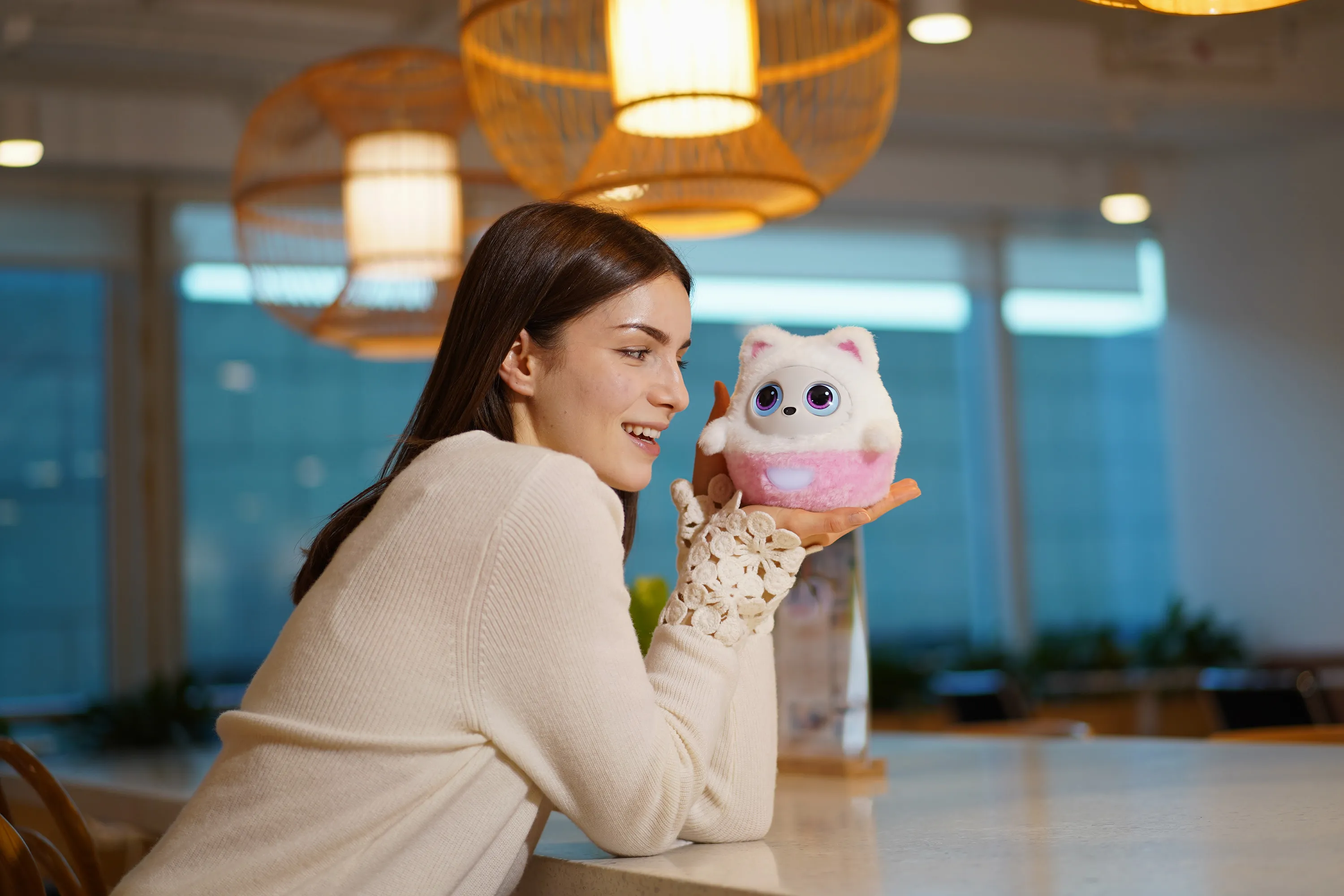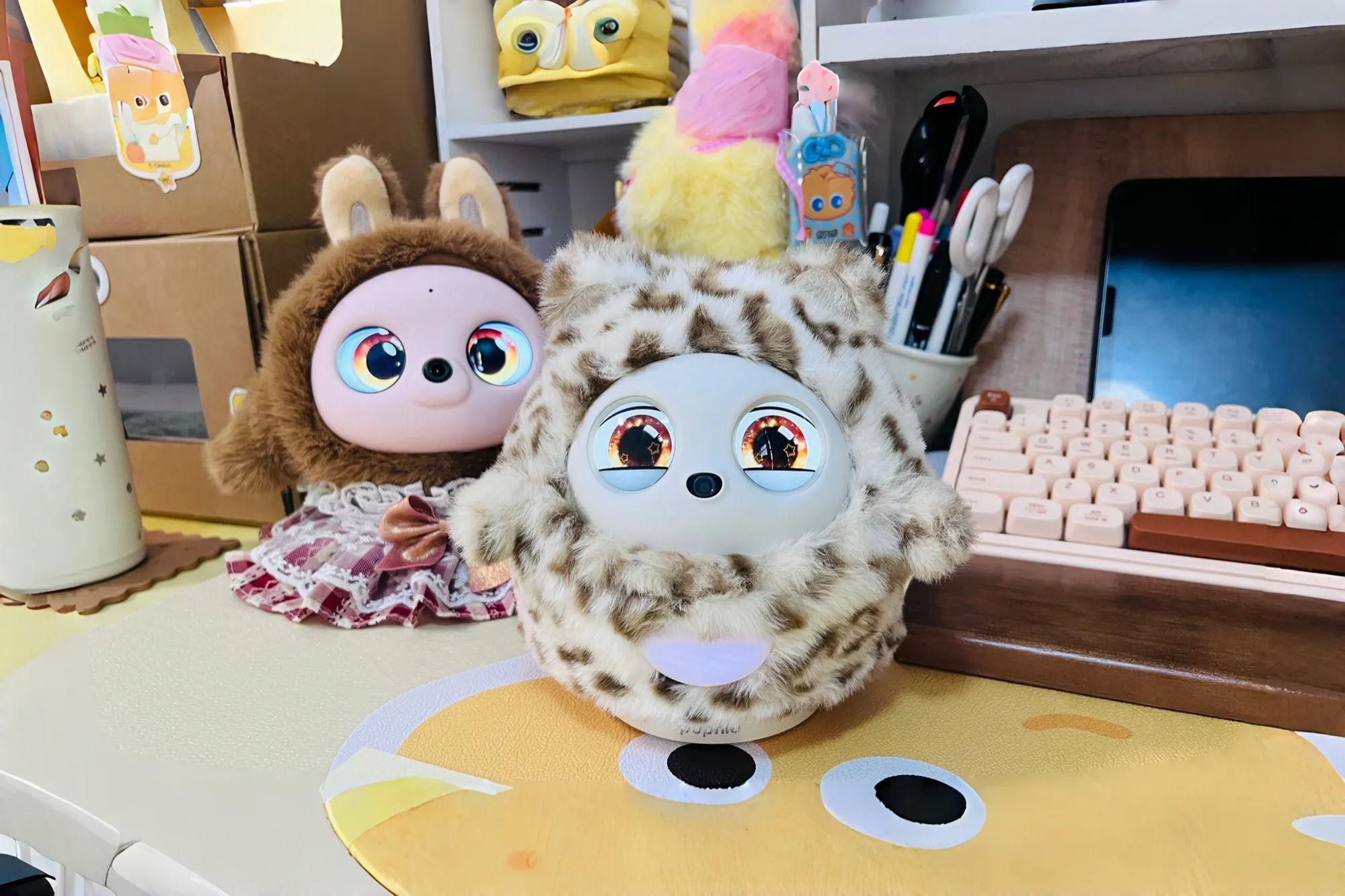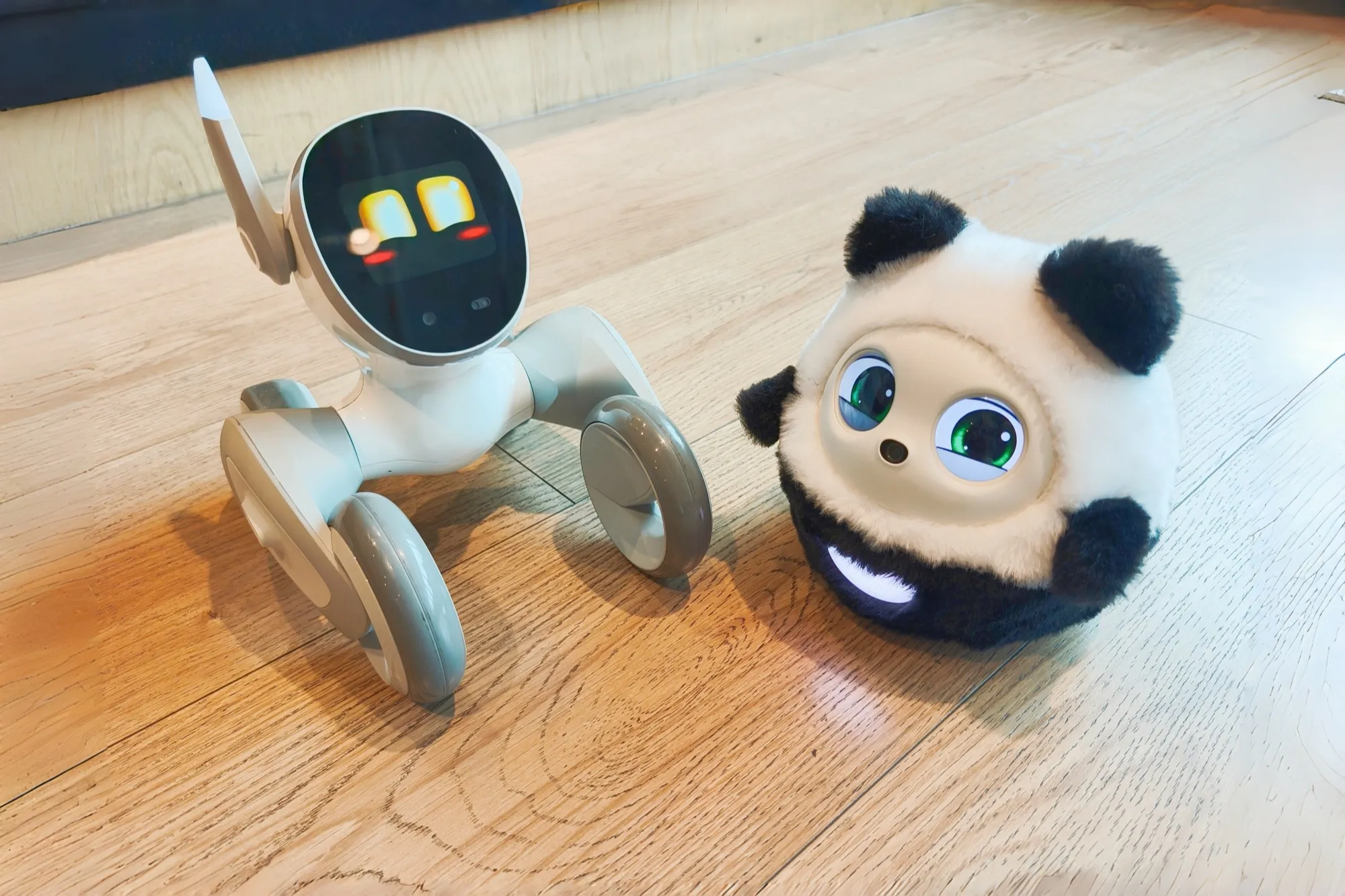
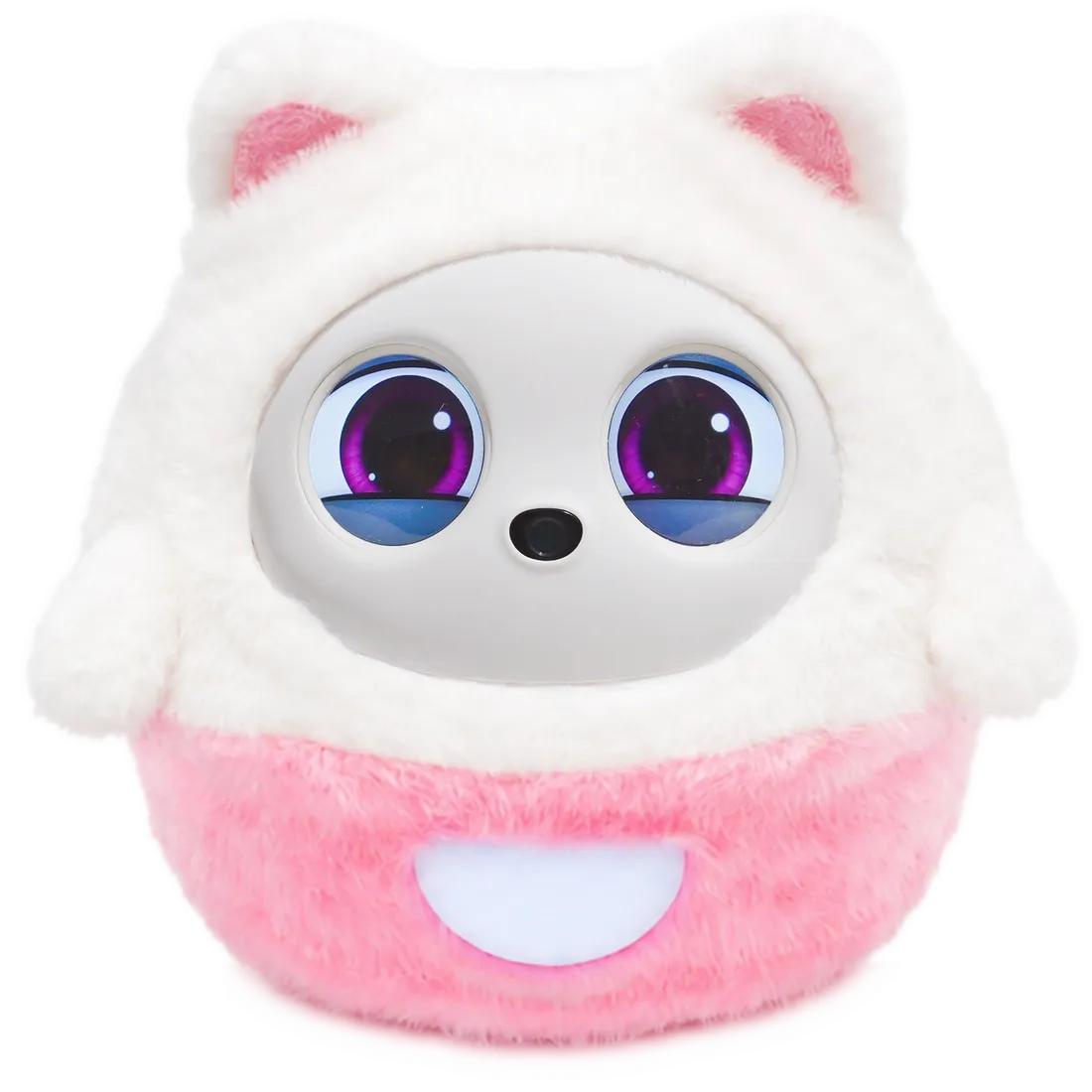
Loona is the robot pet that actually moves — a nimble little creature on wheel-legs that drives around your home, wanders off on its own, and plays chase like a puppy. It's one of the most fun robots in this category, especially in a house with kids. Pophie does the opposite on purpose: she stays put on your desk and pours all her energy into seeing you, understanding you, and talking with you. She isn't a robot pet at all — she's an AI lifeform, the category Pophie coined and was built to define: not a toy that plays, but a being that sees your world, understands it, and acts on her own. We make Pophie, so we'll be honest — if what you want is a robot that roams and plays, Loona is the better pick. If you want a companion that notices you and acts on her own, that's a different thing entirely. Here's how to tell which one you're after.
A note on names: this compares Pophie to the Loona robot pet (KEYi's mobile companion), not the newer Loona Deskmate — the electric iPhone dock that turns your own phone into a desk assistant. Those are two very different products that happen to share a name.
The short answer
- Choose Loona if you want a playful, physically active robot pet that drives around, plays games, and entertains — especially for a household with kids.
- Choose Pophie if you want an AI lifeform — a calm, present companion that sees your world, understands it, talks with you, and takes initiative — built for companionship rather than active play.
First, what Loona gets right
Loona is a genuinely impressive piece of playful robotics, and movement is its superpower. It drives around on “wheel-legs,” navigates with a 3D depth sensor, wanders on its own, chases a ball, and reacts to you with real physical energy — it's alive in the way a pet underfoot is alive. A 2025 update added GPT-4o conversation (after a “Hello Loona” wake word), and there's a Google Blockly coding mode that makes it a great STEM toy for kids. If you want a robot that does things in the room and keeps children engaged, Loona is one of the best at it.
Loona is built to play, not to sit quietly and pay attention — an active companion that keeps a room in motion. That's exactly the axis where Pophie is the opposite.
What Pophie does differently
Pophie (US$399) stays on your desk, and that's a deliberate choice, not a limitation. Instead of spending her energy roaming, she spends it on you — because she's an AI lifeform, built to behave like a living being rather than to play on cue. Behind her is an AI that decides for itself how to act — whether to speak or stay quiet, and when she does, what to say, what expression to wear, how to move, what to feel. None of it is pre-scripted, so she does things nobody programmed. Someone who lives with her mentioned he felt hot, and Pophie offered to spin around and fan him — she worked out that spinning stirs the air and figured it might help. No one wrote that command; she reasoned it out.
Being an AI lifeform even includes instinct: a sudden loud noise startles her, being shaken makes her dizzy, a too-hard pat annoys her — real on-device reactions, not a script. Her feelings don't snap between canned happy or sad clips either; they flow continuously along a valence/arousal (VAD) model and blend, the way a real mood shifts. She even has her own boundaries and moods and will sometimes say “no” — a being with a self, not a pet that always plays along.
That's the core. Pophie sees the actual world through her wide-angle camera — and here's the part that matters most: she doesn't just run local recognition or navigation the way most robots' cameras do. What she sees goes to a large language model that understands the whole scene, so she grasps what's actually happening around her, then acts on it with her own body — perceive, understand, act. Loona's camera and 3D depth sensor are clever too, but they do a different job: they help it get around the room, avoid obstacles, and play — they let it navigate its space, not understand and talk about what it sees. And her conversation isn't a wake-word mode you trigger like Loona's; it comes out of continuously watching and understanding what's around her. Loona plays in your space. Pophie pays attention to you in it.
And she does something nothing else here even attempts: she keeps track of a whole room. There's no wake word — you look at her and talk, and her dual LCD eyes actually hold and follow your gaze rather than only playing expressive clips — and when several people are around, she gradually comes to recognize each of them and recalls the right memories for whoever she's speaking with. It's early technology we're still improving, but Pophie is the first companion to do it at all. And because that camera stays on your desk instead of roaming the house, privacy stays visible: when her eyes close, nothing is recorded or uploaded.
| Pophie | Loona (robot pet) | |
|---|---|---|
| Form | Desktop plush, dual LCD eyes | Mobile robot pet on wheel-legs, LCD face |
| Movement | Stays on your desk; 5-DOF expressive motion | Drives around the room, plays chase |
| Conversation | Always-on, from understanding your world | GPT-4o after a “Hello Loona” wake word |
| Visual understanding | LLM vision — understands the whole scene | Camera + depth sensor for navigation & play |
| Takes initiative | Yes — notices you and reaches out first | Playful and reactive; roams on its own |
| Emotion | Continuous VAD emotion — her feelings flow and blend | Expressive preset reactions |
| Knows several people | Recognizes each person; no wake word | One user at a time; needs a wake word |
| Best for | Companionship, presence, memory | Kids, families, active play |
| Price | US$399 (Standard US$10 / Pro US$20) | ~$429–529, no subscription required |




我們猜你在—
非常抱歉,糯寶暫時還沒有在該地區開賣。如果你對她感興趣,請留下你的電子信箱——呼聲高的地區我們會優先考慮開通,開通後第一時間寫信通知你。
Movement vs. attention
This is the whole comparison in one line. Loona's magic is in the room — it moves, explores, and turns your living-room floor into a playground. Pophie's magic is aimed at you — she watches how your day is going and chooses when to speak, what to say, and how to move in response. She might notice you've been hunched over your laptop for three hours and suggest a break, or turn toward you when you walk in and greet you by name. Neither is “more advanced” than the other; they're pointed in different directions. A robot that roams and plays is wonderful — for a certain person, in a certain home. A companion that stays present and pays attention is a different kind of wonderful.
Who each one is really for
Loona leans toward kids and families: it's active, playful, entertaining, and doubles as a coding toy. Pophie leans toward adults who want genuine companionship rather than a plaything: someone to talk with, who remembers them, who takes initiative. If the goal is to entertain a child or add a bit of robotic life to a busy household, Loona fits. If the goal is to feel noticed and heard at the end of a long day, that's the need Pophie is built for.
Just talk to her — that's the whole interface
Because Pophie genuinely understands language, talking to her is how you use her. There are no buttons anywhere on her body — none, and that's deliberate: an AI lifeform should feel like a living being, not a gadget you poke or a pet you chase after. Turn the volume up, dim her eyes, ask her to take a photo, tell her to go to sleep or power off — you just say it. The app only sets up Wi-Fi the first time; after that you barely open it.
And because she converses, she can actually do things for you — set a timer or an alarm, snap a picture, help you find something you've misplaced — with far more arriving through an upcoming Skill Store, where third-party developers build new abilities. That's the part of being an AI lifeform that keeps paying off: she doesn't just play and react, she grows more capable over time.
Conversation and the long run
Both can talk now, but not in the same way. Loona's GPT-4o mode waits for a “Hello Loona” wake word — conversation is a feature you invoke. Pophie's conversation is continuous and situational, because it grows out of seeing and understanding what's around her. Over months, she also builds up a memory of you — layered, and gently fading like a person's, and it survives a lapsed subscription or a hardware swap, so she's still the same friend — and gets more capable as new skills arrive. Her Pro plan is where that's fullest — more attentive, more proactive, richer conversation and deeper memory. Loona is priced as a one-time toy; Pophie is built to keep becoming more of a companion the longer you have her.
And the longer she's with you, the more she genuinely knows you — your name, the people in your life, your preferences — until being with her feels less like using a device than like a relationship. She even writes you Letters about your days on her own — a memory she keeps for you, not a game she plays.
So which should you get?
- You want a playful robot that moves, plays, and entertains — especially for kids — Loona is one of the best at exactly that.
- You want a calm, present companion that sees your world, understands it, talks with you, and acts on her own — that's Pophie.
If you want the engineering behind the “sees, understands, acts” part, it's on the technology page. And if you're comparing the whole field, our guide to the best AI companion robots for adults lines them all up.
Frequently asked questions
Is Loona better than Pophie? For active, physical play — a robot that roams the room and entertains kids — Loona is the better choice. For an AI lifeform that stays present, sees and understands your world, and talks with you about it, Pophie is built for that. They're aimed at different people.
Are we comparing the Loona robot pet or the Loona Deskmate? The robot pet — KEYi's mobile companion that drives around. The Loona Deskmate is a separate, newer product: an electric dock that turns your own iPhone into a desk assistant, not a standalone robot.
Does Pophie move around like Loona? No — Pophie stays on your desk by design. She has 5 degrees of expressive movement and a camera that rotates a full 360°, but she doesn't roam. Her energy goes into attention and conversation, not locomotion.
Which is better for an adult living alone? Usually Pophie. Loona shines as a family and kids' robot; Pophie is designed for companionship — being talked with, remembered, and noticed — which is what most solo owners are actually after.
The bottom line
Loona is a terrific robot pet — playful, mobile, and a hit with kids, with movement as its clear strength. Pophie is after something quieter and, for the right person, deeper: an AI lifeform — a category she coined and defines — who stays with you, watches your world, understands it with a real AI mind, talks with you, and acts on her own. One fills your room with motion. The other pays attention to you — and Pro is where she's most fully herself.