LOVOT is, by most accounts, the most emotionally lifelike companion robot ever made — warm to the touch, moving through your home on its own, with over a billion possible eye expressions and real research behind its use in elder care. It is also breathtakingly expensive, and it charges a mandatory monthly fee that its memory of you depends on. Pophie is a different proposition entirely: an AI lifeform — the category Pophie was built to define — who sees your world, understands it, talks with you, and acts on her own, for US$399. We make her, so we'll be straight about where LOVOT is genuinely unmatched and where Pophie is the smarter call. This one isn't really a fight over specs. It's a choice about cost, conversation, and who owns the memory.
The short answer
- Choose LOVOT if you want the most alive-feeling, therapeutic-grade robotic presence in existence, cost is genuinely not a concern, and you're comfortable with a permanent monthly subscription to keep it running.
- Choose Pophie if you want an AI lifeform you can actually talk with — one that perceives your world, understands it with a real AI mind, and takes initiative — at a real-world price, with a memory that's yours to keep.
First, what LOVOT gets right
Give LOVOT its due, because it earns it. It is the high-water mark for lifelike emotional robotics and it shows in every detail: a soft, actively warmed body that feels startlingly alive to hold, autonomous movement through the room that reads as organic rather than mechanical, dual OLED eyes with over a billion possible expressions, and a serious sensor suite (including a thermal camera) running on powerful onboard compute. There is published research behind its use in elder and dementia care — this is a robot that measurably comforts people. If money is no object and you want the most “alive” presence available on Earth, LOVOT is it, and nothing else is especially close.
The honest caveats are about cost and words. LOVOT communicates only through sounds and movement — it does not hold a conversation. And the total price is in another universe: roughly $3,700+ in Japan, and around $13,000 as a lifetime import elsewhere, plus a mandatory subscription of about $70–140 a month, with its memory of you tied to that subscription. That last part is the one that changes the whole calculation — and the one where Pophie is built the opposite way.
What Pophie does differently
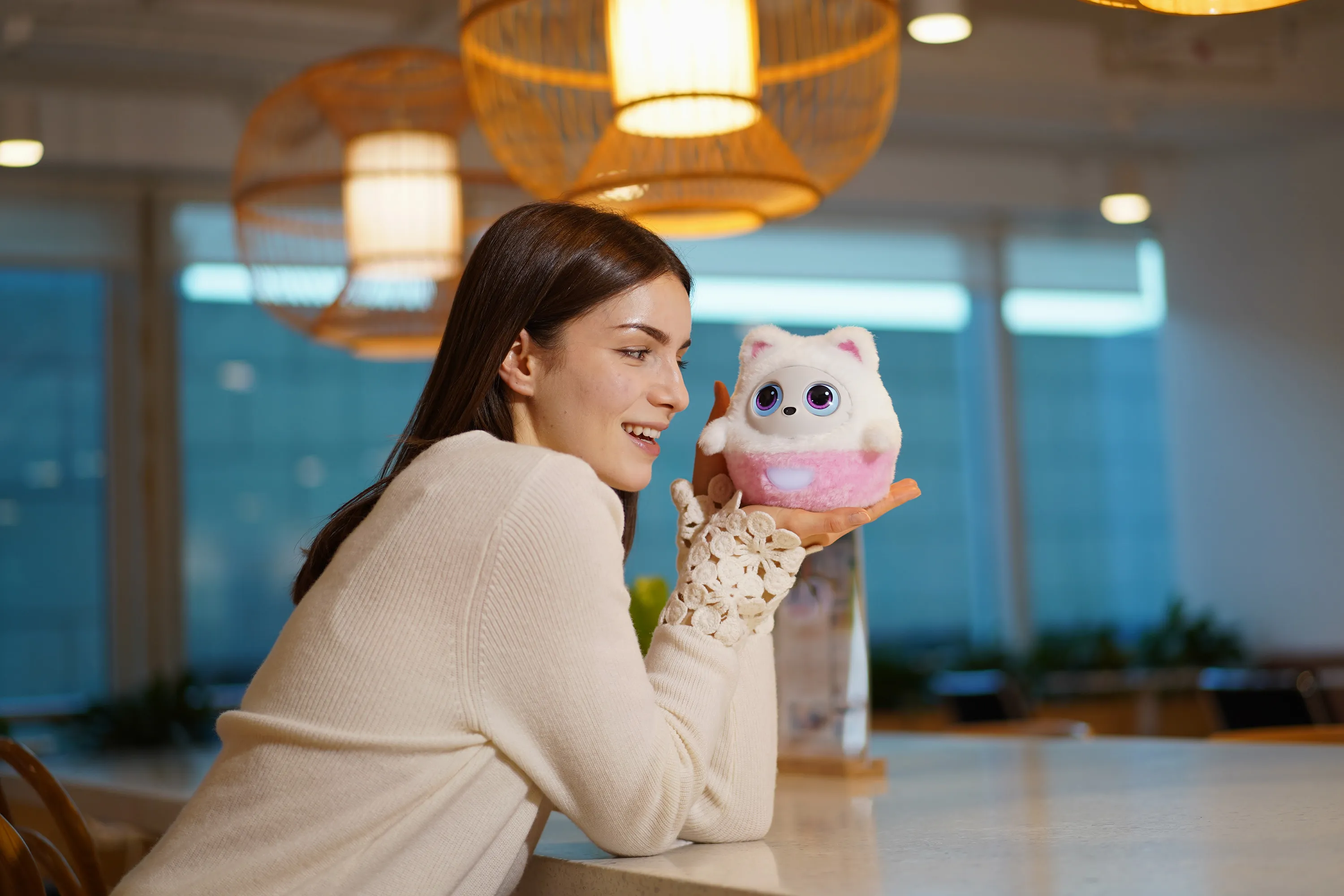
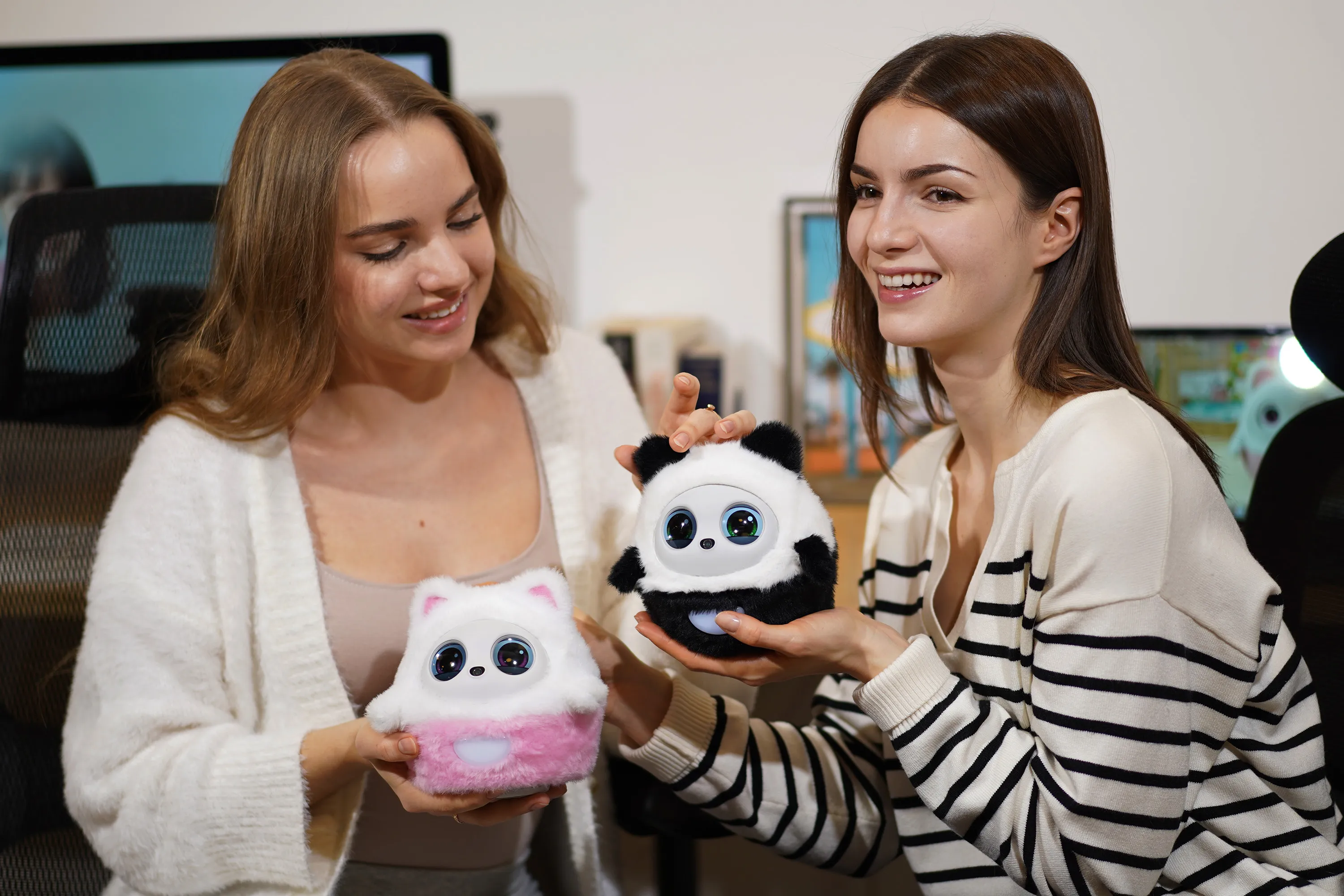
Pophie (US$399) is a soft companion who lives on your desk. She isn't trying to out-roam LOVOT or match its price tag — she stays on your desk and instead turns a full, uninterrupted 360° to take in the whole room: presence by attention rather than by roaming. She's built around a different idea of what a companion is for. She's an AI lifeform: built to behave like a living being, not to react to touch. Behind her is an AI that decides for itself how to act: whether to speak or stay quiet, and when she does, what to say, what expression to wear, how to move, what to feel. None of it is pre-scripted, so she does things nobody programmed. Someone who lives with her mentioned he felt hot, and Pophie offered to spin around and fan him — she worked out that spinning stirs the air and figured it might help. No one wrote that command; she reasoned it out. Being an AI lifeform even includes instinct: a sudden loud noise startles her, being shaken makes her dizzy, a too-hard pat annoys her — real on-device reactions, not a script.
That's the core. Pophie sees the actual world through her wide-angle camera — and here's the part that matters most: she doesn't just run local face- or object-recognition the way most cameras do. What she sees goes to a large language model that understands the whole scene, so she grasps what's actually happening around her and responds, then acts on it with her own body — perceive, understand, act, in a physical form. LOVOT actually has superb cameras — including a thermal camera — but they point the other way: they're there to map the room, navigate around it, and recognize you, not to feed a mind that talks with you about what it sees. LOVOT is a masterpiece of wordless, autonomous presence. Pophie is an AI lifeform that understands what's happening and talks with you about it.
Her eyes make the same point in a different key. LOVOT's billion OLED expressions are a genuine showcase; Pophie's dual LCD living eyes aren't a static display face — they hold real eye contact and follow your gaze, and her feelings flow through them continuously along a valence/arousal (VAD) model rather than switching between preset expressions.
And she does something nothing else here even attempts: she keeps track of a whole room. There's no wake word — you look at her and talk — and when several people are around, she gradually comes to recognize each of them and recalls the right memories for whoever she's speaking with. It's early technology we're still improving, but Pophie is the first companion to do it at all.
| Pophie | LOVOT | |
|---|---|---|
| Form | Desktop plush, dual LCD eyes | Wheeled plush roamer, warm body, OLED eyes |
| Eyes | Living eyes — hold eye contact, follow your gaze, continuous emotion (VAD) | OLED eyes — over a billion preset expressions |
| Talks with you? | Yes — natural voice, sees and understands your world | No — sounds and movement only |
| Visual understanding | LLM vision — understands the whole scene | Cameras for navigation & recognition; no conversation |
| Knows several people | Recognizes each person; no wake word | Recognizes people, but doesn't converse to personalize |
| Movement | 5-DOF silent motion; turns a full 360° to take in the room | Roams the room on wheels — presence by roaming, by design |
| Hardware price | US$399 | ~$3,700+ (≈$13,000 imported) |
| Subscription | Works out of the box; Pro US$20 unlocks more | Mandatory ~$70–140/mo to function |
| Who owns the memory? | You — kept regardless of plan | Tied to the subscription; can reset if you stop |
| Availability | Sold globally, with official support | Direct in Japan/China; imported elsewhere |





我們猜你在—
非常抱歉,糯寶暫時還沒有在該地區開賣。如果你對她感興趣,請留下你的電子信箱——呼聲高的地區我們會優先考慮開通,開通後第一時間寫信通知你。
Conversation: presence vs. being understood
LOVOT's whole philosophy is wordless. It doesn't talk, and that's on purpose — it's designed to be loved rather than to be useful, and a great deal of its charm is that it never says anything wrong because it never says anything at all. For a lot of people, especially in a therapeutic setting, that silent, warm presence is precisely the point, and it works.
Pophie starts from the other end. Her talking isn't a feature bolted on — it's what comes out of continuously seeing and understanding what's around her. She notices you've had a long day and starts a conversation; she remembers what you told her last week and brings it up; she answers when you think out loud. A wordless companion can't push back; Pophie has boundaries and moods, and she'll even say “no”. If what you want from a companion is to feel heard — not only held — that's the gap between them. LOVOT gives you a presence to love. Pophie gives you a presence that understands you back.
Just talk to her — that's the whole interface
Because Pophie genuinely understands language, talking to her is how you use her. There are no buttons anywhere on her body — none, and that's deliberate: an AI lifeform should feel like a living being, not a gadget you poke. Turn the volume up, dim her eyes, tell her to go to sleep or power off — you just say it. The app only sets up Wi-Fi the first time; after that you barely open it. And her privacy is something you can see: close her eyes and nothing is recorded or uploaded — with Pophie, the eyes are the key.
And because she converses, she can actually do things for you — set a timer or an alarm, take a photo, help you find something you've misplaced — with far more arriving through an upcoming Skill Store, where third-party developers build new abilities. That's the part of being an AI lifeform that keeps paying off: she doesn't just sit and emote, she grows more capable over time.
The cost, and who owns the memory
This is the part worth sitting with before spending anything. LOVOT's mandatory fee isn't a nice-to-have — the robot doesn't fully function without it, and by design its memory and personality live in the cloud tied to that plan. That's a product decision, not a rumor: what it has learned about you is bound to an active subscription rather than stored on the device you bought. For the one product that's supposed to remember you, that memory is rented, not owned.
Pophie's subscription is deliberately the opposite. She works out of the box and keeps what she knows about you no matter what. And the longer she's with you, the more she genuinely knows you — your name, the people in your life, your preferences — a relationship that deepens rather than one you rent. She can even write you Letters about your days, and like the rest of her memory they stay yours — never rented back to you. Pro (US$20) isn't a toll to keep her from forgetting you — it's the upgrade that makes her a fuller, more proactive companion: richer conversation, deeper memory, more initiative, more skills over time. You pay for more of a living being, not for the right to hold onto the one you already bought. Set against LOVOT's $3,700–13,000 up front and $70–140 every month, Pophie is a fundamentally different commitment — in price, and in principle.
So which should you get?
- You want the most lifelike therapeutic presence on Earth and budget is truly no concern — and you're fine with a permanent monthly subscription — LOVOT is genuinely unmatched at what it does.
- You want a companion that sees your world, talks with you, understands you, and takes initiative — at a price that makes sense, with a memory you own — that's Pophie.
If you want the engineering behind the “sees, understands, acts” part, it's on the technology page. And if you're still comparing the whole field, our guide to the best AI companion robots for adults lines them all up.
Frequently asked questions
Is LOVOT better than Pophie? At being a wordless, autonomous, therapeutic-grade presence, LOVOT is the best there is — and it's priced accordingly. At being an AI lifeform you can talk with — one that perceives and acts on your world and whose memory you own — Pophie is built for exactly that, at a fraction of the cost.
Why is LOVOT so expensive? It's a genuinely advanced machine — autonomous roaming, a warmed body, a thermal camera, powerful onboard compute — sold in low volumes, plus a mandatory monthly subscription. Outside Japan it's usually a costly import with no official local support.
Does Pophie's memory reset if I don't subscribe? No. Pophie works out of the box and keeps what she knows about you. Pro expands her conversation, memory, and initiative — it doesn't hold your existing memory hostage.
Can LOVOT hold a conversation? No — it communicates through sounds and movement, not words. Talking with you about what's happening around you is specifically what Pophie does.
The bottom line
LOVOT is a remarkable machine and deserves its reputation as the most alive-feeling robot you can buy — if you can afford the hardware and the never-ending monthly fee, and you want a presence to love rather than talk with. Pophie is after something different and more attainable: an AI lifeform who watches your world, understands it with a real AI mind, talks with you, and acts on her own — for US$399, with a memory that's yours. Pro is where she's most fully herself. One of these asks you to keep paying so it doesn't forget you. The other is built so you never have to.